Table of Contents
- Why High Speed Door Problems Matter
- Problem 1: The Door Does Not Open or Lift Properly
- Problem 2: Sensor or Activation Problems
- Problem 3: Curtain, Belt, Cable, or Slat Damage
- Problem 4: Misaligned Tracks or Door Travel Issues
- Problem 5: Wear, Fatigue, and Unplanned Downtime
- Problem 6: Weather, Ice, Dust, and Harsh Conditions
- How to Prevent High Speed Door Problems
- Final Thoughts
Why High Speed Door Problems Matter
High speed doors are built to improve workflow, reduce energy loss, and support safe movement in warehouses, factories, cold rooms, and logistics centers. But when a door stops working correctly, the impact can spread quickly across the whole facility. A damaged or unreliable door can interrupt traffic flow, increase energy loss, create safety risks, and raise maintenance costs.
Recent manufacturer guidance shows that many service calls are tied to practical operating issues such as doors that no longer lift properly, motor failure, torn curtains, belts, or cables, unresponsive sensors, and signs of wear that were not addressed early through inspection and maintenance. Understanding these problems and their solutions can help facilities reduce downtime and extend door life.
Problem 1: The Door Does Not Open or Lift Properly
One of the most disruptive issues is a door that does not open, does not lift fully, or stops partway through its cycle. According to ASSA ABLOY’s industrial door repair guidance, a common fault is a door that no longer lifts, often linked to drive or motor-related issues. In high-cycle facilities, even a short interruption can slow forklift movement and affect loading schedules.
The solution starts with checking the power supply, control panel status, and fault indicators. If the problem points to a motor or control-system failure, the safest response is prompt professional repair. For SEO and buyer education purposes, it is useful to explain that delayed repair often increases workflow disruption, especially at busy warehouse openings.
Problem 2: Sensor or Activation Problems
High speed doors often rely on motion sensors, radar devices, loop detectors, or photo eyes to trigger opening and maintain safe operation. When these components stop responding, the door may fail to open on approach, close unexpectedly, or operate inconsistently. Rite-Hite specifically lists unresponsive sensors as a common maintenance issue, while ASSA ABLOY recommends cleaning and monitoring sensors and motion detectors regularly.
The solution is regular inspection, cleaning, and testing of all activation devices. Dirt, condensation, impact, or ice buildup can affect sensor performance. In exterior or cold-weather environments, facilities should also make sure thresholds and nearby operating areas are kept clear so the detection system works consistently.
Problem 3: Curtain, Belt, Cable, or Slat Damage
In fast-moving industrial environments, physical damage is one of the most common door problems. High traffic from forklifts and carts can lead to torn curtains, damaged belts, worn cables, broken slats, or spring-related failures. ASSA ABLOY’s high speed door repair page notes that torn curtains, belts, and cables should be treated as priority repairs, while damaged slats and springs also require rapid attention.
The right solution depends on the damaged component, but the main principle is simple: do not keep running the door after visible damage appears. Small tears or alignment problems can quickly become larger operational failures. In facilities with frequent impact risk, a better long-term solution may be to choose a model with self-repairing curtain features or a door type designed for heavy-duty traffic.
Problem 4: Misaligned Tracks or Door Travel Issues
Track misalignment can cause rough movement, uneven travel, excessive noise, or a door that jams during operation. Although many maintenance guides discuss this issue in the broader context of industrial and loading dock doors, Rite-Hite identifies misaligned door tracks as a common maintenance problem. In practice, similar alignment issues can affect high speed doors when the opening receives repeated impacts or when wear is not corrected early.
The solution is to inspect guide structures, mounting points, and curtain travel regularly. If the door begins moving with a stiff, jerking, or uneven motion, that is often a sign the system needs service. Rite-Hite also advises paying attention to unusual sounds or juddering movement, as these are early warning signs that maintenance is needed.
Problem 5: Wear, Fatigue, and Unplanned Downtime
Even advanced high speed doors are still mechanical systems with moving parts that experience wear over time. ASSA ABLOY’s maintenance guidance for high speed doors emphasizes that regular checks can identify signs of wear before they become operational problems. This is especially important in facilities where doors cycle hundreds of times per day.
The solution is preventive maintenance rather than waiting for failure. Facilities should schedule inspections for minor components, fasteners, seals, activation devices, and moving assemblies. This approach not only reduces emergency service calls, but also helps preserve speed, safety, and sealing performance over the long term.
Problem 6: Weather, Ice, Dust, and Harsh Conditions
Environmental conditions can also create door problems, especially in exterior openings, freezer rooms, or dusty industrial sites. In cold weather, ice buildup can affect sensors and thresholds. In dirty environments, dust can interfere with detection devices and moving components. ASSA ABLOY specifically recommends cleaning sensors, checking for ice buildup, and keeping tracks and thresholds clear.
The solution is to match maintenance practices to the operating environment. For cold storage or outdoor openings, regular cleaning and anti-icing measures are especially important. For exterior applications, selecting the right door type from the start also matters. As Rytec’s recent guidance on exterior fabric doors explains, exterior openings demand control over traffic, temperatures, and operating costs, so product selection and application fit are part of the maintenance equation.
How to Prevent High Speed Door Problems
The best solution is prevention. The most useful maintenance advice across recent manufacturer resources is consistent: inspect regularly, respond early to wear, clean sensors and operating areas, and repair visible damage before it spreads. Regular inspections help catch wear and fatigue early, while attention to unusual noise, stiffness, or rough motion can identify problems before full breakdown happens.
Facilities can reduce service issues further by:
- training operators to report unusual movement or sounds immediately;
- keeping sensors, guides, and thresholds clean;
- repairing torn curtains, belts, or cables without delay;
- checking alignment after any forklift impact;
- using preventive maintenance plans for high-cycle openings.
For buyers comparing products, this also reinforces an important point: the right high speed door is not only about speed. It is also about durability, ease of maintenance, safety systems, and fit for the actual application.
Final Thoughts
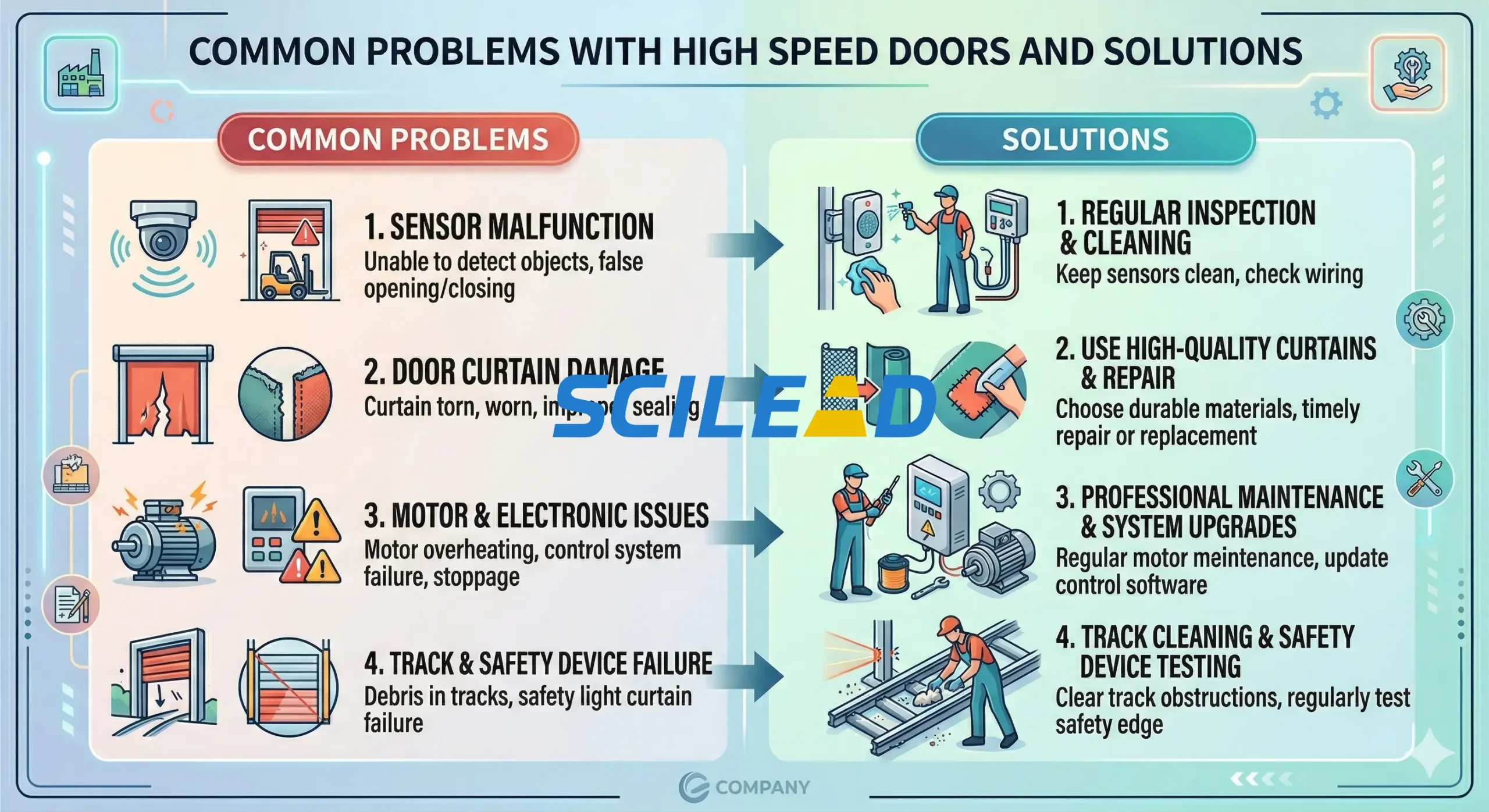
Common problems with high speed doors usually fall into a few clear categories: opening failure, sensor issues, physical damage, misalignment, wear, and environmental interference. The good news is that most of these problems can be reduced or solved through regular inspection, fast repair response, and choosing a door that matches the operating environment.
For modern industrial facilities, a high speed door is too important to treat as a simple building accessory. When it works properly, it supports productivity, safety, and energy control. When it is neglected, even a small fault can turn into costly downtime. That is why preventive maintenance and application-based door selection remain the most practical long-term solutions.