Table of Contents
- Why Energy Saving Matters
- How Industrial Doors Affect Energy Use
- Key Energy Saving Benefits of High Speed Doors
- Best Applications for Energy Saving High Speed Doors
- What Features Improve Energy Efficiency
- How to Choose the Right Door
- Final Thoughts
Why Energy Saving Matters
Energy costs are a major concern for warehouses, factories, cold storage facilities, and distribution centers. In buildings with frequent traffic and large openings, energy loss can happen every time a door stays open too long. Recent industry guidance from Rytec and ASSA ABLOY emphasizes that high-performance and tight-sealing door systems are increasingly important because they help reduce heat loss, maintain climate control, and support more efficient building operation.
For industrial facilities, energy saving is not only about insulation in walls and roofs. It also depends on how effectively openings are managed. That is why high speed doors are now viewed as part of a broader energy-efficiency strategy rather than just an access solution.
How Industrial Doors Affect Energy Use
Traditional industrial doors often move slowly and may remain open longer than necessary. This increases air exchange between indoor and outdoor areas or between two zones with different temperatures inside the same building. According to ASSA ABLOY, smart entrance systems can reduce energy consumption by adjusting opening, closing, and hold-open time. Rytec also notes that high-performance doors help reduce the energy needed to heat and cool a building.
The issue becomes even more important in high-traffic settings such as loading docks, warehouses, clean areas, and cold chain operations. In these environments, even small delays in door closing can add up to significant heating, cooling, or refrigeration losses over time.
Key Energy Saving Benefits of High Speed Doors
1. Reduced Air Exchange
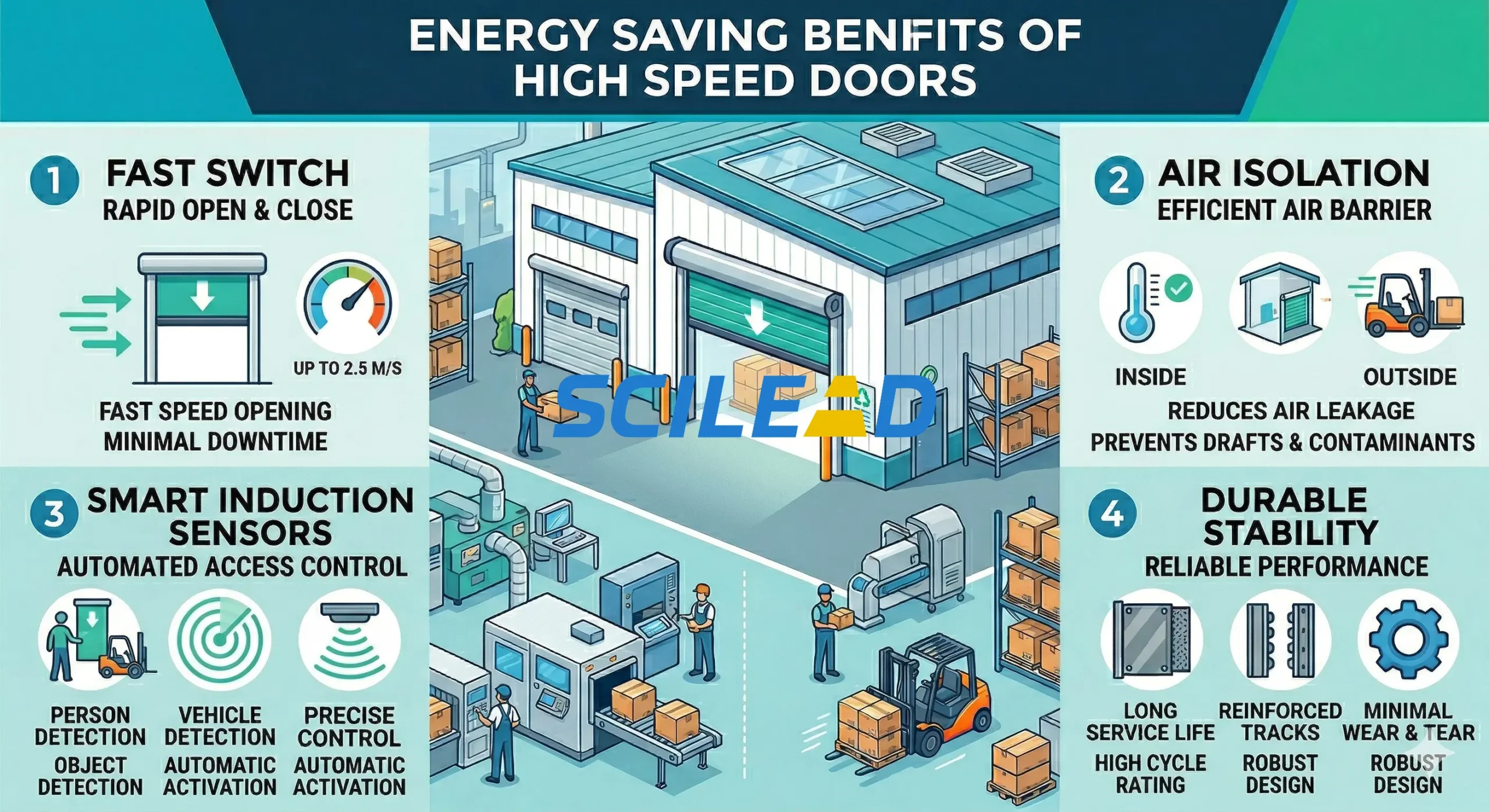
One of the biggest energy saving benefits of a high speed door is that it opens and closes quickly, which reduces the time an opening is exposed. This helps limit the amount of warm air, cool air, humidity, dust, or outdoor air moving through the opening. Rite-Hite explains that high speed door performance can minimize air exchange and help protect temperature-sensitive products as well as worker comfort.
2. Better Temperature Control
When less air escapes, indoor temperatures remain more stable. This means HVAC and refrigeration systems do not need to work as hard to restore target conditions after every door cycle. ASSA ABLOY highlights that tight-sealing frames and efficient door systems help reduce heat loss and maintain interior climate control, especially in exterior door applications.
3. Lower Heating and Cooling Costs
Reducing unnecessary airflow directly supports lower energy use. Rytec states that high-performance doors help reduce the amount of energy needed to heat and cool a building. For facilities with many daily cycles, this can translate into meaningful long-term savings.
4. Improved Efficiency in High-Traffic Openings
Busy openings create the greatest risk of energy loss because doors cycle more frequently. High speed doors are especially valuable in these locations because they combine fast movement with reliable repeat performance. In a recent product document, ASSA ABLOY’s ecoLOGIC material says intelligent door control can reduce heating and cooling losses at high-traffic entrances and save up to 14,000 kWh per year per door in some applications.
5. Better Support for Sustainability Goals
Energy saving doors can also support wider sustainability targets. Rytec links high-performance doors to more sustainable building operation and notes their relevance to LEED-related practices. For companies trying to cut energy waste and improve operational efficiency, high speed doors can contribute to those goals in a practical way.
Best Applications for Energy Saving High Speed Doors
Warehouses and Distribution Centers
Warehouses often have constant forklift movement and repeated openings between storage, picking, and shipping zones. A fast-closing door helps reduce energy waste while keeping traffic moving efficiently.
Cold Storage and Freezer Rooms
In chilled and frozen environments, every second of door-open time matters. Rite-Hite’s energy savings guidance points to high-speed, tight-sealing, insulated cold storage doors as an effective way to improve energy performance in refrigerated applications.
Loading Docks
Loading docks are often major sources of air leakage and temperature loss. Rite-Hite notes that proper exterior doors with effective seals and fast cycle speeds can save between $400 and $7,000 per opening annually, depending on the application and conditions.
Manufacturing and Clean Environments
Facilities that require cleaner air, stable temperatures, or controlled pressure can also benefit from high speed doors. Faster cycles help maintain environmental separation while reducing the energy cost of conditioning indoor air.
What Features Improve Energy Efficiency
Not every industrial door offers the same energy performance. The most important features usually include:
- fast opening and closing speed;
- tight perimeter sealing;
- reliable automatic closing;
- insulated panels or curtains where required;
- smart controls that adjust hold-open time.
Recent guidance from ASSA ABLOY specifically highlights smart controls that dynamically reduce energy consumption, while Rite-Hite emphasizes that faster, secure exterior doors can help save on energy costs.
How to Choose the Right Door
The right door depends on the opening and the environment. For interior traffic separation, a flexible PVC high speed door may be enough. For exterior openings, a rigid or insulated high speed door may provide better sealing, wind resistance, and thermal control. ASSA ABLOY’s recent trend overview suggests that exterior applications increasingly prioritize insulation and tight sealing, while Rytec focuses on minimizing energy use through high-performance operation.
When evaluating options, it is better to look at total cost of ownership instead of only the purchase price. A door that reduces air loss, lowers HVAC demand, and operates reliably under heavy traffic can often deliver better long-term value.
Final Thoughts
The energy saving benefits of high speed doors come from a simple principle: less open time means less energy loss. By reducing air exchange, improving temperature control, and supporting tighter building operation, high speed doors can help industrial facilities lower heating, cooling, and refrigeration costs.
In modern warehouses, factories, and cold chain facilities, a door is no longer just an opening. It is part of the energy management system. Choosing the right high speed door can improve both operational efficiency and long-term building performance.