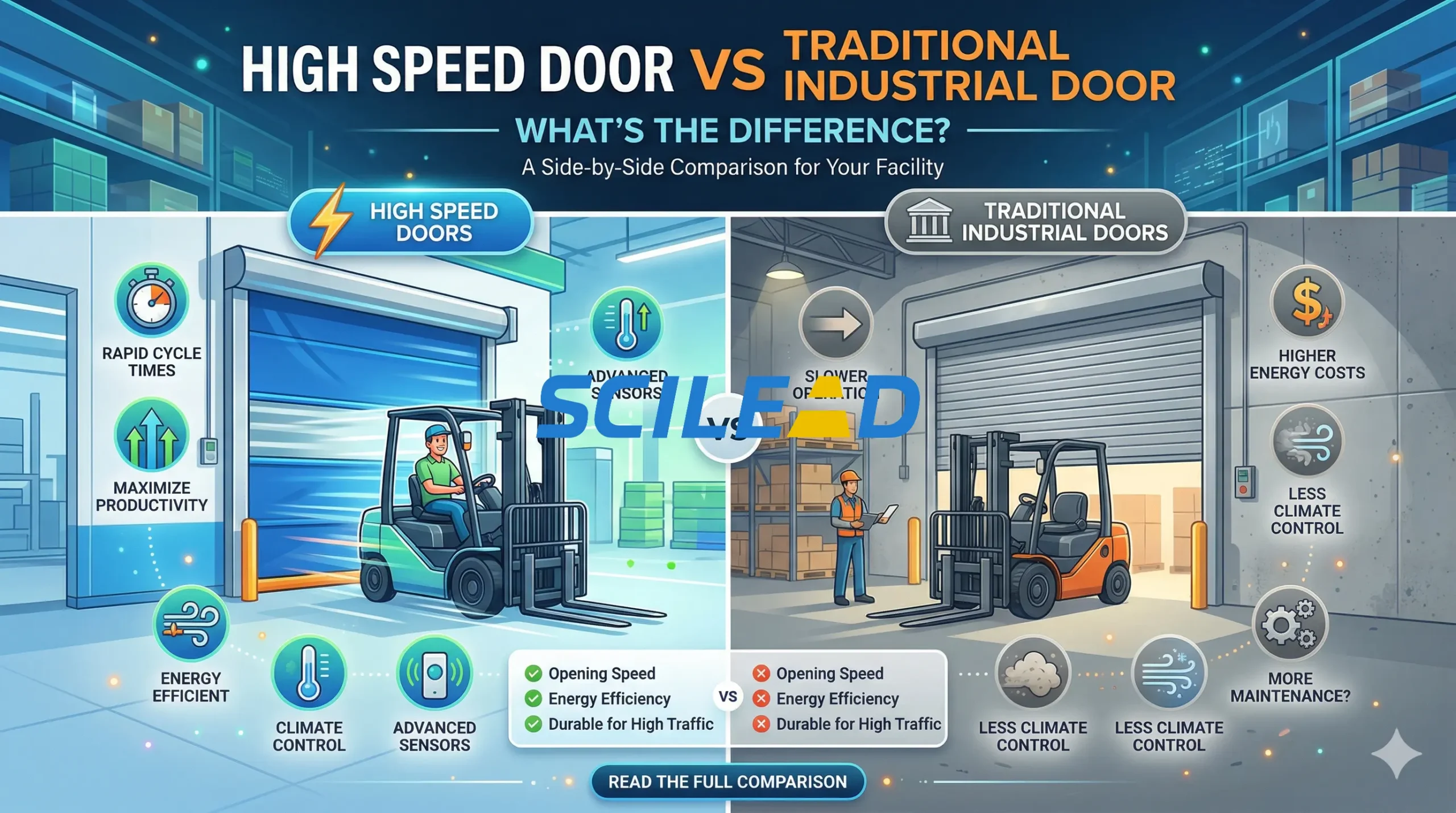
Choosing the right industrial door affects traffic flow, energy use, safety, and operating cost. In simple terms, a high speed door is built for fast opening, frequent cycles, and better environmental control, while a traditional industrial door is usually slower and chosen for basic separation, security, or lower upfront cost. For many factories, warehouses, and clean production areas, the right choice depends on how the opening is used every day.
Table of Contents
- What Is the Difference Between High Speed Doors and Traditional Industrial Doors?
- Opening Speed and Traffic Efficiency
- Energy Savings and Environmental Control
- Safety and Maintenance
- Best Applications for Each Door Type
- How to Choose the Right Door
- Conclusion
What Is the Difference Between High Speed Doors and Traditional Industrial Doors?
The main difference is operating performance. A high speed door opens and closes much faster than a traditional industrial door. It is designed for frequent daily traffic, reduced waiting time, and better separation between areas. A traditional industrial door is often used for general access, security, or simple enclosure, but it usually does not provide the same speed or control.
In practice, high speed doors are common in logistics passages, cleanrooms, food plants, cold chain facilities, and automated production lines. Traditional industrial doors are more often used where opening frequency is lower and speed is not the main priority.
Opening Speed and Traffic Efficiency
This is the clearest advantage in the high speed door vs traditional industrial door comparison. A high speed door is made for fast cycles, which helps forklifts, workers, and AGV systems move without long delays. Faster opening and closing also reduces the time the doorway stays open.
A traditional industrial door can still work well in many facilities, but it is usually slower and less suitable for high-frequency traffic. In busy operations, slower doors can create congestion, affect workflow, and increase exposure to dust, heat loss, or outdoor air.
For facilities with demanding traffic conditions, options such as a Wind-Resistant High-Speed Door or a Metal Spiral High-Speed Door are often more appropriate than standard industrial doors.
Energy Savings and Environmental Control
High speed doors usually perform better when a facility needs tighter environmental control. Because the door cycle is fast, less conditioned air escapes. This matters in temperature-sensitive or cleanliness-sensitive spaces.
In clean production environments, a Cleanroom High-Speed Door helps reduce air exchange and supports cleaner internal separation. In temperature-controlled areas, a Cold Storage Insulated High-Speed Door can help reduce energy loss and maintain more stable conditions.
A traditional industrial door may still provide physical separation, but it is usually less effective where fast closure and repeated insulation performance are important. This is one reason why many facilities shift from conventional doors to high speed door systems over time.
Safety and Maintenance
Both high speed doors and traditional industrial doors can be equipped with safety devices, but their day-to-day operation is different. A high speed door is commonly designed with sensors, photo eyes, and control systems that support frequent and safe movement in active work zones.
Maintenance depends on the door type, site conditions, and usage frequency. Traditional industrial doors may appear simpler, but if they are used in high-cycle openings, wear can become a problem. A high speed door is usually a better fit when the opening is used many times per day and downtime must be minimized.
For tougher exterior conditions, facilities may also compare rigid solutions such as a Steel Galvanized Industrial Door with high speed models to balance strength, security, and operating frequency.
Best Applications for Each Door Type
High speed doors are usually best for:
- Logistics corridors with frequent movement
- Cleanrooms and pharmaceutical workshops
- Cold chain and temperature-controlled areas
- Production lines and AGV access points
- Facilities that want better efficiency and lower air exchange
Traditional industrial doors are usually better for:
- Openings with lower daily cycle counts
- Facilities where speed is not the main concern
- Projects focused mainly on basic closure or perimeter separation
- Applications with tighter initial budgets
How to Choose the Right Door
When evaluating high speed door vs traditional industrial door, ask these practical questions:
- How many times will the door open and close each day?
- Is the opening inside or outside the building?
- Does the area need dust control, hygiene control, or temperature stability?
- Will forklifts, workers, or AGVs pass through frequently?
- Is reduced waiting time important for productivity?
- Do you need stronger wind resistance or tighter sealing?
If the answer points to high traffic, energy control, and faster workflow, a high speed door is usually the better investment. If the opening has lighter use and basic function is enough, a traditional industrial door may still be suitable.
Conclusion
In the high speed door vs traditional industrial door comparison, the difference is not only speed. High speed doors are built for frequent use, better traffic flow, and improved environmental control. Traditional industrial doors are still useful for lower-frequency openings and more basic applications. The best choice depends on operating conditions, traffic volume, insulation needs, and long-term efficiency goals.
For most modern factories, warehouses, and controlled production spaces, a high speed door offers clearer performance advantages when the opening is part of daily workflow rather than just a simple entrance.