Table of Contents
- Why Cleanrooms Need Specialized High Speed Doors
- What Is a Cleanroom High Speed Door?
- Why These Doors Matter in Cleanroom Design
- Key Features to Look For
- Best Door Types for Different Cleanroom Applications
- How to Choose the Right Cleanroom Door
- Common Buying Mistakes to Avoid
- Final Thoughts
Why Cleanrooms Need Specialized High Speed Doors
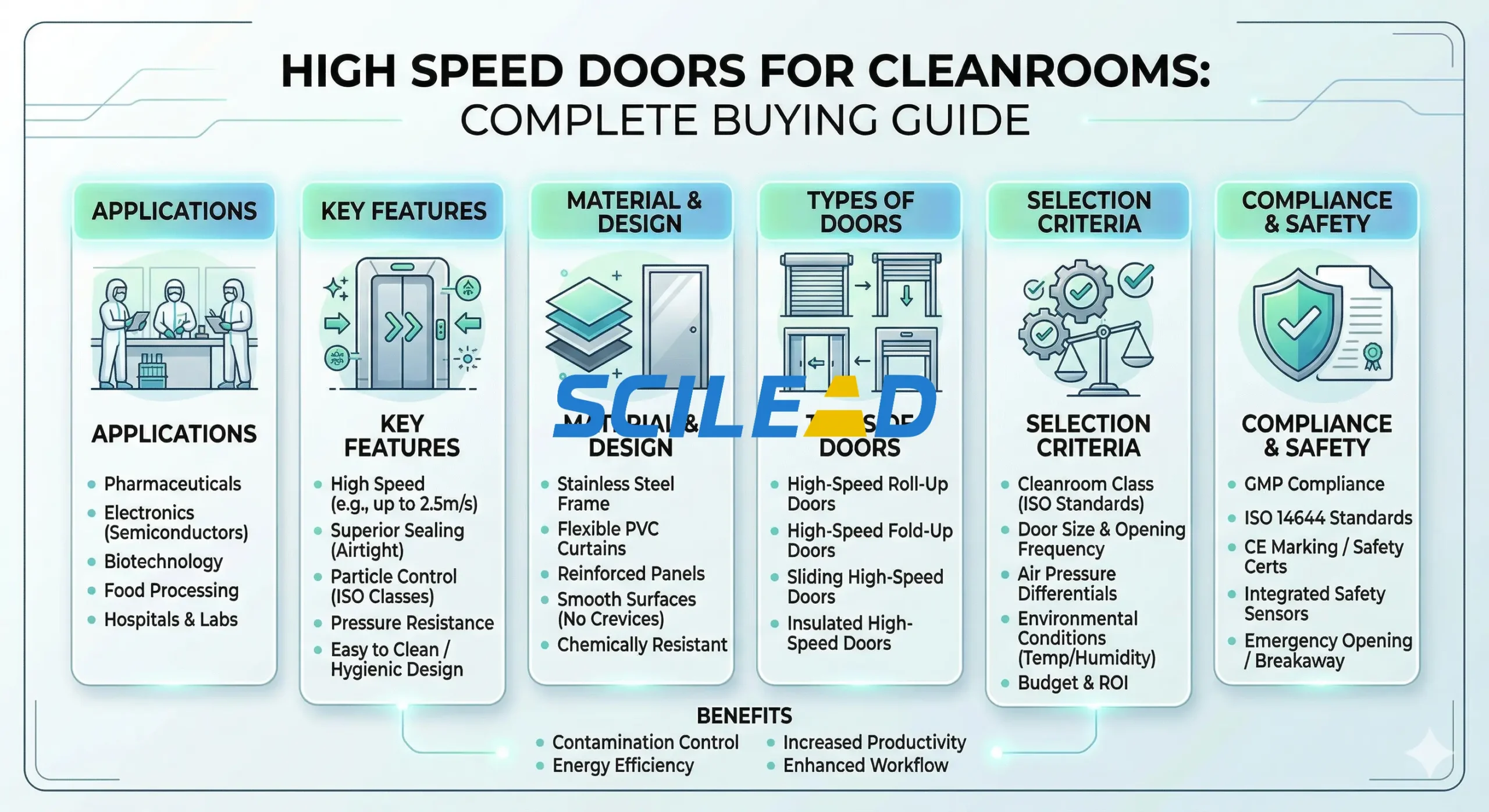
Cleanrooms are controlled environments where airborne particles, pressure balance, temperature, humidity, and surface cleanliness all matter. The international cleanroom framework ISO 14644-1 classifies air cleanliness by particle concentration, while ISO 14644-5:2025 sets out basic requirements for cleanroom operations. In regulated sectors such as pharmaceuticals and aseptic processing, contamination control is also reinforced by FDA guidance.
That is why cleanrooms cannot rely on ordinary industrial doors. A door in this environment must do more than open and close. It needs to help maintain the controlled space, support cleaning, reduce unnecessary air exchange, and fit the workflow of people, carts, pallets, or material transfer between zones. Recent product guidance from ASSA ABLOY, Rite-Hite, and Rytec all emphasize tight sealing, reduced air exchange, hygienic design, and quick operation for cleanroom applications.
What Is a Cleanroom High Speed Door?
A cleanroom high speed door is a fast-operating door designed for controlled environments where cleanliness and environmental separation are critical. Compared with a standard industrial door, it is usually built with smoother surfaces, fewer dirt-collecting points, more cleanable materials, and sealing features that help protect the clean space.
For example, ASSA ABLOY’s HS9130GAT cleanroom door is positioned for lower-ISO-certified cleanrooms, while Rite-Hite’s ISO-Clean cleanroom door line is presented as suitable for facilities working under ISO, cGMP, and Annex 1 expectations. ASI Doors also describes high-speed fabric roll-up doors for pharmaceutical, cleanroom, and GMP applications such as packaging, material transfer, air locks, equipment wash rooms, and staging areas.
Why These Doors Matter in Cleanroom Design
1. They Help Reduce Air Exchange
One of the main reasons to use a high speed door in a cleanroom is to reduce the time the opening is exposed. Rytec states that tight seals and high speeds minimize air exchange between areas. PortaFab’s cleanroom brochure similarly notes that high-speed doors reduce the amount of time the cleanroom is exposed to the outside environment.
This matters because air exchange can affect particle control, pressure cascades, and temperature stability. In many cleanroom applications, a faster door helps maintain a more consistent environment than a slower conventional door.
2. They Support Pressure Control
Cleanrooms often rely on positive or negative pressure differentials between rooms. When doors stay open too long, that balance becomes harder to maintain. FDA inspection observations have even documented situations where a door was not capable of closing due to airflow balance problems, showing how doorway performance can directly affect controlled-room operation.
For this reason, buyers should treat door speed and sealing as part of pressure-control strategy, not just as convenience features.
3. They Improve Cleanability
Cleanroom doors should be easy to clean and designed to reduce particle traps. Rytec highlights minimized seams, corrosion-resistant materials, and mechanical accessibility for cleaning. ASI Doors’ cleanroom case-study guidance explains that cleanroom doors should minimize ledges, crevices, and angles because these areas can collect dirt and bacteria and make cleaning harder.
4. They Help Traffic Move Efficiently
Cleanrooms still need productivity. Operators, carts, pallets, and materials must move in and out without turning the doorway into a bottleneck. ASI Doors presents bi-parting cleanroom doors as a solution for controlled environments facing tighter performance and budget demands, while Rite-Hite describes smart cleanroom door design as helping create a clean, safe, and simple operating environment.
Key Features to Look For
Fast Opening and Closing Speed
Fast cycle speed helps limit exposure time between rooms. This is one of the main reasons buyers choose high speed doors for cleanrooms instead of ordinary swing or slower sliding doors.
Tight Sealing
A cleanroom door should close tightly enough to support environmental separation. Rytec emphasizes tight seals, and ASI Doors says its pharmaceutical door solutions use full-height seals to keep out contaminants and support cleanliness.
Smooth, Easy-to-Clean Surfaces
The door surface and frame design should reduce places where dust or residue can collect. ISO 14644-13 provides guidance on cleaning surfaces in cleanrooms, reinforcing why smooth, accessible surfaces are important.
Material Compatibility
Doors in cleanrooms may need to withstand frequent washdown or chemical cleaning. Rytec highlights corrosion-resistant and chemical-resistant materials, while ASI Doors presents sliding pharmaceutical doors designed for GMP, ISO, FDA, and EMEA requirements.
Appropriate Cleanroom Rating or Application Fit
Not every cleanroom door fits every cleanroom. ASSA ABLOY specifically notes its HS9130GAT for lower-ISO-certified cleanrooms, while BMP Doors presents a high-speed cleanroom door with Fraunhofer ISO 5 certification. Buyers should match the product to the required cleanliness level rather than assuming any “cleanroom door” is sufficient.
Interlocks, Sensors, and Access Control
In air locks and material transfer spaces, door interlocking can be important. PortaFab notes that sliding door options may include motion sensors and interlocks. These features can help protect pressure relationships and traffic discipline between adjacent zones.
Best Door Types for Different Cleanroom Applications
High Speed Roll-Up Doors
These are a strong option where fast access and reduced air exchange matter most. They are commonly used for packaging rooms, material transfer, and internal process areas. ASI Doors specifically places them in air locks, staging, packaging, and equipment wash rooms.
Sliding Cleanroom Doors
Sliding doors are often chosen where a more rigid panel system, strong seal, or specific cleanability profile is preferred. ASI Doors and STANLEY Access Technologies both offer cleanroom-oriented sliding solutions for pharmaceutical, biotech, medical, and industrial controlled environments.
Bi-Parting Doors
Bi-parting doors can be useful where fast, centered access is needed and wall layout allows the opening pattern. They are often used in life sciences and process rooms where material flow is important.
Specialized ISO-Rated Cleanroom Doors
Where classification requirements are strict, buyers may need products marketed with specific ISO suitability or certification claims, such as BMP Doors’ ISO 14644-1 Class 5 cleanroom door materials or other validated cleanroom-specific systems.
How to Choose the Right Cleanroom Door
Start with the Cleanroom Class and Process Risk
The first question is not door type. It is process requirement. Buyers should begin with the cleanroom classification, contamination risk, and whether the area handles sterile, aseptic, pharmaceutical, biotech, medical device, or electronics production. ISO 14644-1 and FDA aseptic guidance provide the broader framework for understanding how controlled these environments need to be.
Review the Traffic Pattern
Is the opening mainly used by personnel, carts, pallets, or automated transfer systems? A high-frequency materials corridor may benefit most from a high speed door, while a lower-frequency sterile boundary may prioritize sealing and cleanability even more strongly.
Think About Cleaning and Maintenance
A door that is hard to clean or difficult to service can become a weak point in cleanroom operation. Buyers should look for doors with accessible components, hygienic finishes, and minimal dirt traps.
Check for Interlocks and Automation Needs
If the opening is part of an air lock, pass-through, or pressure cascade, interlocking and access control may be necessary. If the room supports automated movement, door controls should match the process flow.
Match the Door to the Opening
A compact material-transfer opening may not need the same door solution as a large pallet-access cleanroom entrance. The best buying decision comes from matching the door to the specific room function, not just choosing the most expensive or fastest model.
Common Buying Mistakes to Avoid
One common mistake is choosing a standard industrial high speed door and assuming it is good enough for cleanroom use. Another is focusing only on speed while ignoring surface design, sealing, material compatibility, and classification fit.
Buyers should also avoid relying on only one vendor’s marketing language. A stronger evaluation combines official standards, regulatory guidance, and product information from multiple suppliers such as ASSA ABLOY, Rite-Hite, Rytec, ASI Doors, and PortaFab.
Final Thoughts
A cleanroom high speed door is more than a fast doorway. It is part of contamination control, pressure management, cleaning strategy, and production flow. The best solution depends on the cleanroom class, the process being protected, the traffic pattern, and the level of sealing and cleanability required.
For many buyers, the smartest approach is to start with the cleanroom standard and the process need, then compare several door technologies and suppliers. When chosen correctly, a cleanroom high speed door can help protect product quality, maintain controlled conditions, and improve daily operating efficiency at the same time.