Table of Contents
- Why Door Lifespan Matters
- How Long Do High Speed Doors Last?
- Why Lifespan Is Measured in Cycles
- What Affects the Lifespan of a High Speed Door?
- How to Extend High Speed Door Life
- When Should You Repair or Replace a Door?
- Final Thoughts
Why Door Lifespan Matters
For warehouses, factories, cold storage facilities, and logistics centers, a high speed door is not just an opening. It is part of the daily operating system. When a door lasts longer and performs reliably, the facility benefits from better uptime, smoother traffic flow, and lower long-term maintenance costs. When it wears out too early, the result can be more downtime, more repairs, and higher operating expense.
That is why lifespan matters when comparing door systems. In high-cycle environments, buyers should look beyond the purchase price and consider how long the door is likely to perform under real working conditions.
How Long Do High Speed Doors Last?
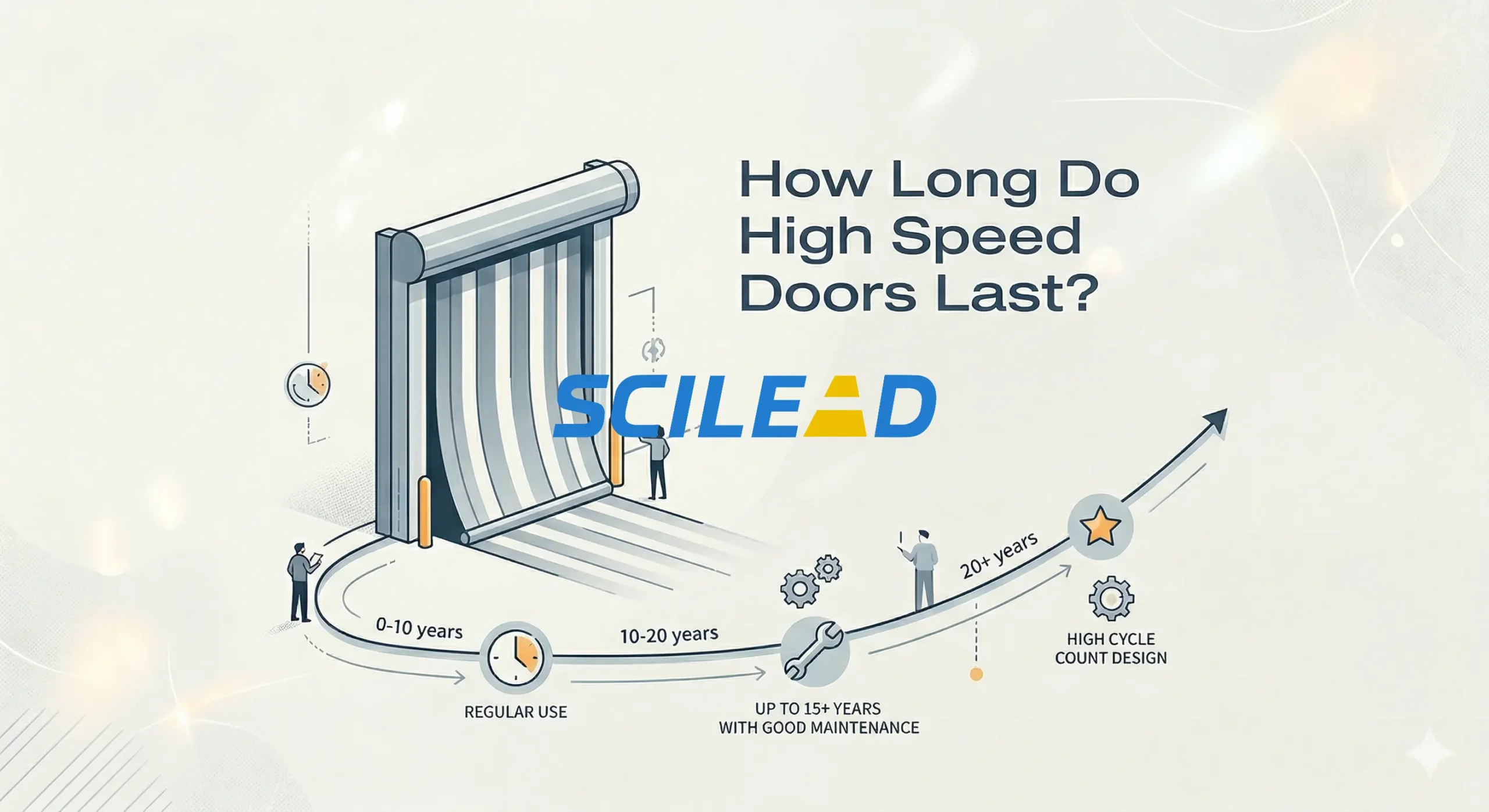
In most industrial applications, high speed doors are designed to last for millions of operating cycles with minimal maintenance. Recent manufacturer guidance from Rytec states that high-performance doors should last for millions of cycles, while the company’s 2022 long-life article gives real examples of doors exceeding 2 million, 4 million, 6 million, and even 9 million cycles.
In other words, there is no single fixed answer such as “10 years” or “15 years” for every door. The real lifespan depends on how often the door cycles, what environment it operates in, how well it is maintained, and whether it is the right door for the application. A properly selected and maintained high speed door in a busy facility can last for many years, while a poorly matched or neglected door may wear out much sooner.
Why Lifespan Is Measured in Cycles
High speed door lifespan is usually discussed in cycles rather than only in calendar years because these doors are often used many times per day. A “cycle” means one full opening and closing movement. In a high-traffic opening, a door may cycle dozens or even hundreds of times daily.
This is important because heavy use accelerates wear on moving parts. At the same time, modern high-performance doors are specifically designed for high-cycle use. Rytec’s recent 2026 sustainability article notes that high-performance doors are usually specified for more than 75 cycles per day, and Rite-Hite’s recent buyer guidance emphasizes the importance of high-cycle durability in demanding facilities.
Compared with conventional overhead doors, high speed doors are built for much heavier use. Rytec explains that standard overhead doors rely on torsion springs that limit the number of cycles, leading to a shorter operational lifespan than high-performance doors.
What Affects the Lifespan of a High Speed Door?
1. Daily Cycle Count
The more often a door opens and closes, the more stress it places on the system. A door in a low-traffic room may last much longer in calendar years than a similar door at a busy loading dock, even if both are built to high standards.
2. Door Design and Build Quality
Door design plays a major role in service life. According to Rytec’s cold storage guidance, high-performance doors can exceed 2 million cycles and even outlast expected lifespan because their design avoids the constant metal-to-metal contact common in conventional doors. Newer models also focus on minimizing wear. For example, ASSA ABLOY’s recent RT1000 launch article says its operating system is designed to ensure stable travel while minimizing wear and maximizing uptime.
3. Maintenance Practices
Maintenance has a direct effect on door longevity. ASSA ABLOY recently noted that lowering unnecessary opening cycles can reduce wear, decrease maintenance needs, and extend door lifetime. Rytec also stresses that routine maintenance should follow the owner’s manual. In practice, inspections, cleaning, lubrication where specified, and early repair of minor damage all help protect long-term performance.
4. Operating Environment
Exterior openings, freezer rooms, dusty plants, and high-impact forklift areas are all harder on a door than a clean, protected interior opening. Cold, moisture, dirt, and accidental impacts can all shorten service life if the door is not designed for those conditions.
5. Proper Application Match
A door lasts longer when it is used where it was intended to be used. For example, a light-duty interior door installed at a harsh exterior opening may wear quickly. Choosing the correct model for traffic level, pressure conditions, temperature demands, and impact risk is one of the best ways to improve lifespan from the start.
How to Extend High Speed Door Life
The best way to extend the life of a high speed door is to combine the right product choice with regular maintenance. Recent manufacturer materials increasingly point to predictive and preventive strategies. Rite-Hite’s 2025 Raptor Rigid launch highlights Predictive Spring Life technology, which analyzes size, weight, and usage to help replace springs before unexpected failure. Rytec also notes that predictive maintenance reminders can reduce downtime and extend door lifespan.
Facilities can also improve longevity by:
- keeping sensors, tracks, and thresholds clean;
- repairing tears, alignment issues, or impact damage early;
- monitoring cycle counts in high-use openings;
- using the correct door type for interior, exterior, cold storage, or cleanroom use;
- following a scheduled service plan instead of waiting for failure.
When Should You Repair or Replace a Door?
A high speed door should not be replaced only because it is old in years. The better question is whether it still operates safely, reliably, and efficiently for the application. If a door has frequent breakdowns, increasing maintenance costs, persistent alignment problems, worn structural components, or no longer matches the facility’s traffic demands, replacement may be more cost-effective than repeated repair.
On the other hand, many high speed doors continue performing for a very long time when maintained well. Rytec’s documented examples of doors reaching several million cycles show that long service life is realistic when the door is properly selected, installed, and maintained.
Final Thoughts
So, how long do high speed doors last? In most cases, the best answer is that a quality high speed door is built to last for millions of cycles, and in the right environment it can remain productive for many years. The true lifespan depends on cycle frequency, design quality, maintenance, environment, and whether the model fits the job.
For buyers and facility managers, that means the smartest approach is not to ask only how cheap a door is today. It is to ask how reliably it will perform over time. A high speed door with strong durability, proper maintenance, and the right application fit will usually deliver the best long-term value.