Table of Contents
- Why Safety Features Matter
- 1. Light Curtains and Photo Eyes
- 2. Soft Bottom Edge and Reversing Edge
- 3. Breakaway and Auto Re-Feed Systems
- 4. Warning Lights, Traffic Lights, and Audible Alerts
- 5. Vision Panels and Visibility Features
- 6. Self-Monitoring and Safety Diagnostics
- Why Safety Works Best as a System
- How to Choose the Right Safety Features
- Final Thoughts
Why Safety Features Matter
High speed doors are designed for busy industrial environments where forklifts, carts, vehicles, and pedestrians may all pass through the same opening many times a day. In that kind of setting, speed alone is not enough. A modern high speed door also needs safety systems that help prevent collisions, reduce entrapment risk, and keep traffic moving in a more predictable way.
Recent manufacturer guidance makes this clear. Rytec notes that high-performance doors are equipped with many safety features and warning lights, while Rite-Hite explains that a high speed door’s most important job is to open and close quickly and safely every time it is needed. Understanding these features helps buyers choose the right door for both protection and productivity.
1. Light Curtains and Photo Eyes
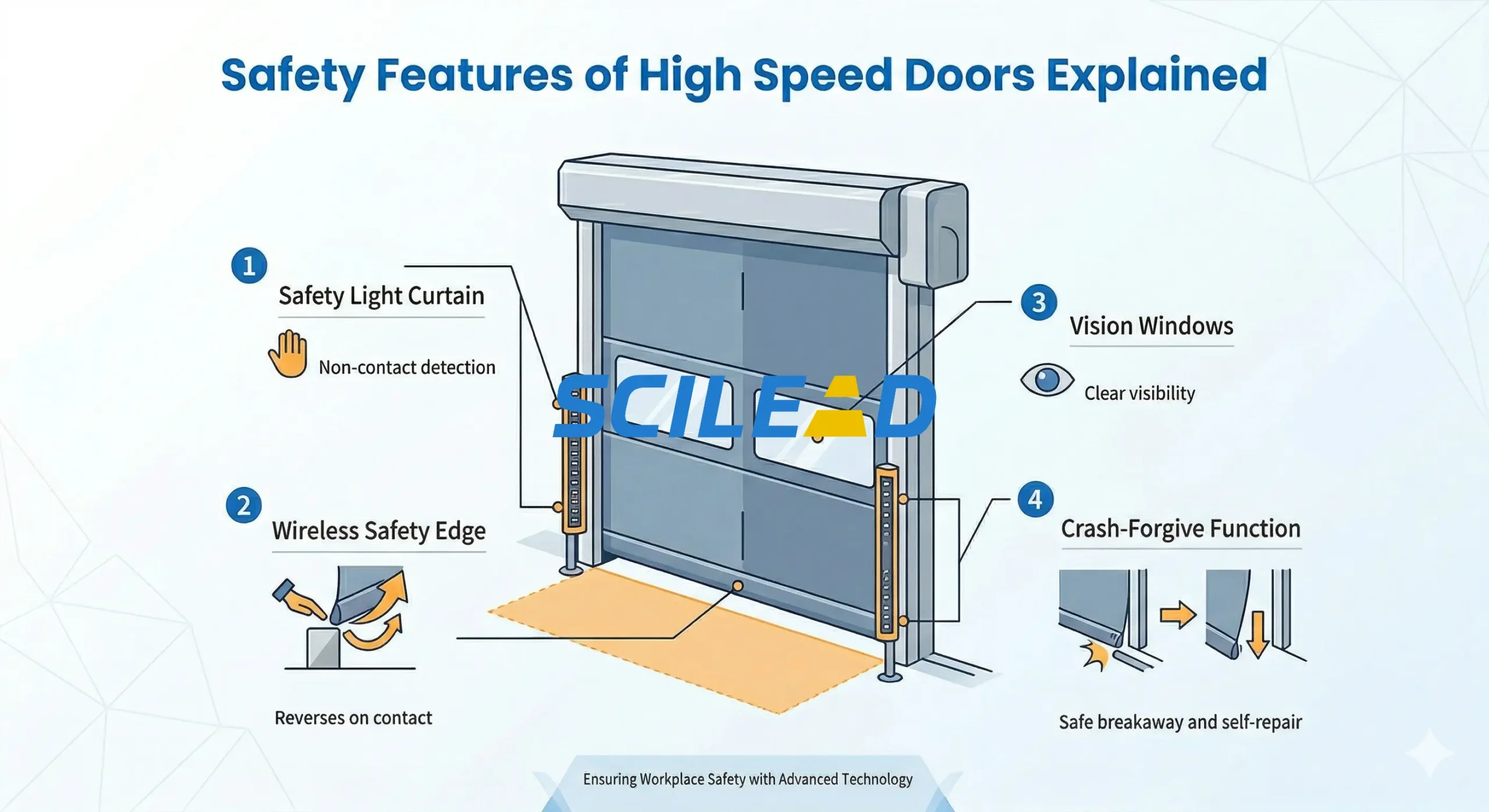
One of the most common safety features on high speed doors is the use of light curtains or thru-beam photo eyes. These devices detect people, forklifts, or objects in the doorway and stop or reverse the closing door before contact occurs.
Rite-Hite states on its FasTrax product page that safety starts at the plane of the door with photo eyes or a light curtain. On its Raptor Rigid page, the company also says an integrated light curtain in the side columns can detect presence better than traditional photo eyes because it creates a bigger detection field. Similarly, an ASSA ABLOY RR3000 leaflet describes a light grid integrated into the side frames to eliminate contact with objects and people in the doorway.
In simple terms, these systems help the door “see” the opening before it closes. They are especially useful in warehouses, loading docks, and other areas where traffic is frequent and fast.
2. Soft Bottom Edge and Reversing Edge
Another important safety feature is the soft bottom edge. On flexible fabric doors, the lower edge is often designed to be soft rather than rigid, which helps reduce injury risk if contact occurs. Rite-Hite’s LiteSpeed page says safety is enhanced by the curtain’s soft bottom edge together with a reversing edge and optical safety devices.
ASSA ABLOY also describes this principle in product literature. The HS9040G leaflet lists an optional bottom safety edge for impact reversal, while the HS9030GAT datasheet explains that a wireless detection device in the soft bottom beam detects an obstruction under a closing door and reverses the door.
This matters because the bottom edge is the part most likely to meet a person, pallet, or forklift at closing height. A soft and responsive lower edge adds an important second layer of protection.
3. Breakaway and Auto Re-Feed Systems
In real industrial environments, accidental impacts still happen. That is why many high speed doors include breakaway or self-resetting designs. These systems allow the curtain to release from its side guides after an impact and then return into place automatically during the next cycle.
Rite-Hite describes this on the FasTrax page as Soft-Breakaway Technology and says the door can re-feed itself on the fly without human intervention after accidental impact. The FasTrax XL page and FasTrax FR page make similar claims. ASSA ABLOY’s HS9020GHY datasheet says its automatic reset system allows the curtain to release after impact and reinsert itself during the next opening and closing cycle.
This feature improves safety in an indirect but very practical way: it reduces damage, limits downtime, and helps the door return to normal operation quickly instead of becoming a hazard after a collision.
4. Warning Lights, Traffic Lights, and Audible Alerts
Safety is not only about stopping the door when something is in the opening. It is also about giving people and vehicle operators more warning before the door moves. Many high speed doors include flashing lights, pre-close alerts, and traffic-control signals.
Rytec’s recent retrofit guidance mentions that high-performance doors are equipped with warning lights. On the rigid-door side, Rite-Hite’s Raptor Rigid page highlights its Door-Commander SafeAlert system, which tells teams how much time remains before the door closes, plus optional LED Virtual Vision and pre-announce-to-close alerts for forklift operators and pedestrians.
ASSA ABLOY product documentation also includes these types of warnings. The HS9030GAT datasheet lists red and orange warning lights, green open-position lights, acoustic signals, and optional red-and-green traffic lights to direct one-way vehicle movement. These features are especially useful at parking structures, loading areas, and exterior openings where cross-traffic risk is higher.
5. Vision Panels and Visibility Features
Another safety feature that is sometimes overlooked is simple visibility. If pedestrians or drivers cannot see through the door or around it, the risk of collision increases. To address this, some door systems include vision windows, vision slats, or transparent panels.
Rytec’s 2026 parking-security article says optional vision slats provide visibility through the door, helping improve safety and traffic control. ASSA ABLOY’s HS9120G document lists optional clear PVC windows and vision panels, while the HS9020GHY datasheet says vision panels can improve visibility across the doorway.
This kind of passive safety feature is valuable because it helps prevent incidents before sensors even need to react.
6. Self-Monitoring and Safety Diagnostics
Modern high speed doors increasingly include self-monitoring functions that watch performance, wear, and safety-system integrity. This is important because a safety device only helps if it is working properly.
An ASSA ABLOY user manual published in January 2026 explains that the system includes built-in self-diagnostics analyzing performance, wear, sensors, and safety-systems integrity. If monitoring fails, the door stops and requests service. Although that manual is for a revolving door line, the principle is relevant to automated door safety more broadly: smart diagnostics help detect faults before they become operational risks.
For high speed doors in demanding applications, self-monitoring adds value by supporting preventive maintenance and making safety systems easier to manage over time.
Why Safety Works Best as a System
No single feature makes a high speed door fully safe on its own. The best protection comes from combining multiple systems. A typical safety package may include a light curtain or photo eyes, a soft bottom detection beam, warning lights, and an impact-recovery system.
This layered approach matters because industrial traffic is unpredictable. A forklift might enter late, a pedestrian may hesitate in the opening, or an operator may approach from the blind side. Multiple safety features reduce the chance that one missed event turns into an accident.
How to Choose the Right Safety Features
The right safety setup depends on the application. For interior warehouse doors, photo eyes, a soft bottom edge, and auto re-feed may be enough. For exterior openings or parking structures, warning lights, traffic-direction signals, and better visibility features may become more important. For doors used by both forklifts and pedestrians, broader detection zones such as integrated light curtains can offer stronger protection.
Buyers should also consider traffic speed, daily cycle count, visibility conditions, automation level, and how quickly the door needs to recover from accidental impacts. A door used hundreds of times per day in a busy logistics facility should not rely on the same safety configuration as a lower-traffic opening.
Final Thoughts
Safety features on high speed doors are designed to do more than prevent contact. They help manage traffic, improve visibility, reduce unexpected movement, and keep the opening operating reliably after minor impacts. The most important features usually include light curtains or photo eyes, soft bottom edges, reversing systems, breakaway and auto re-feed functions, warning lights, visibility panels, and monitoring systems.
For modern industrial facilities, those features are not optional extras in many cases. They are part of what makes a high speed door suitable for real-world use. Choosing the right combination of safety features helps protect people, equipment, and workflow at the same time.