

Pharmaceutical, electronics, laboratory and food processing facilities demand strict indoor control over temperature, humidity and cleanliness. Preserving pressure differentials is critical to managing these environments.
Even if a cleanroom has a HVAC system opening the doors often causes more air to move between different areas, which makes it harder to keep the correct pressure difference.
In this case, High-speed doors for cleanroom are very helpful. This type of high-speed doors help protect the pressure difference by keeping the door open for time and stopping extra air from leaking when the door is shut.
However, the high-speed door itself cannot maintain a pressure differential. Its performance is contingent upon factors such as the door’s design, the integrity of the perimeter seals, the frequency of operation, the layout of the rooms, and the building’s air-handling system.
This guide explores how high-speed cleanroom doors influence pressure differentials, the technical elements that engineers should evaluate during the selection process, and how to choose the most appropriate door for a controlled environment.
What Is Pressure Differential in a Cleanroom?
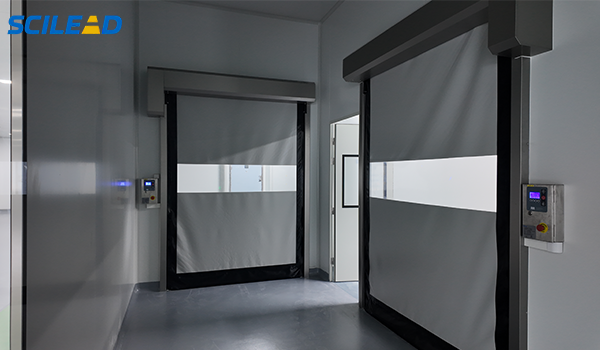
A positive-pressure cleanroom has higher air pressure inside than outside. When the door opens, air flows out. This keeps dirty outside air from entering.A negative-pressure room has lower air pressure inside than nearby spaces. Air flows into this room. This traps airborne contaminants and stops them from spreading to other areas.
The needed pressure difference depends on the facility’s use, contamination risks, and HVAC design.
Pressure rules differ between rooms. When picking a door, focus first on airflow direction and room pressure plan. Do not just choose a door that opens fastest.
Why Door Openings Can Disturb Cleanroom Pressure
A door at physical level is a wall between two rooms. In order to keep a stable pressure in a room, several things have to be kept under control when a door is opened:
- Air exchange: Air moves between adjacent rooms and could reverse direction of air flow when a door is opened.
- Pressure balancing: The increased area of a door opening can be used to off-set increased pressure differences between adjacent rooms as a function of HVAC system design and ambient conditions.
- Movement of personnel and materials: This can include people,production carts and equipment etc. through doorways to generate extra airflow.
- Frequent traffic: opening and closing of doors frequently impedes an HVAC system’s attempt to maintain defined operational parameters.
Minimizing the duration for which a door remains open helps limit these disturbances.That’s the reason why many cleanroom facilities opt for high-speed doors.
How Do Cleanroom High Speed Doors Help Maintain Pressure Differential?
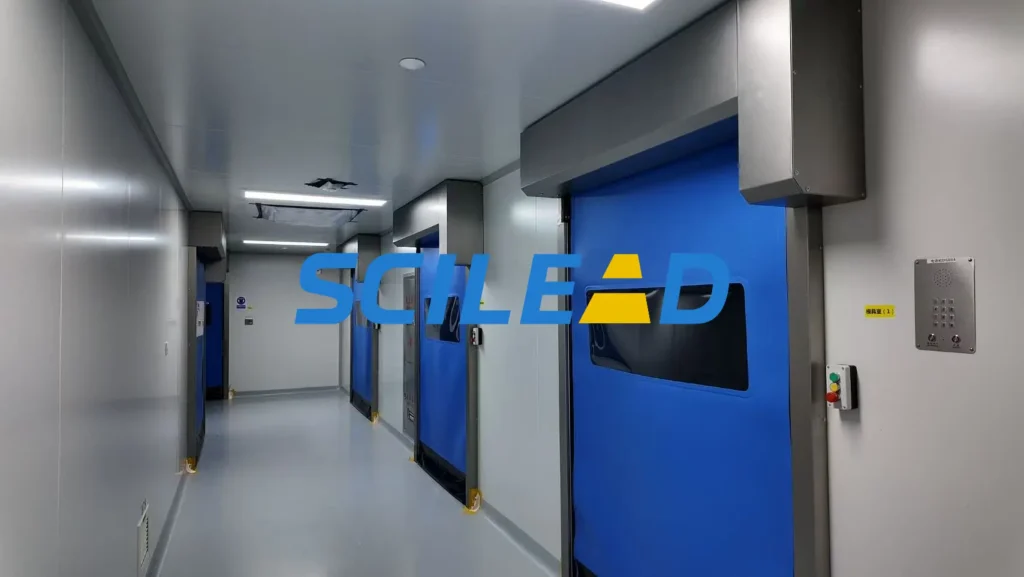
Faster Opening and Closing Reduce Exposure Time
High-speed doors for cleanrooms operate significantly faster than traditional doors, drastically reducing the duration for which an opening remains exposed.
The disruption of the pressure differential mostly happens when doors open and air mixes between inside and outside. Quick passage cuts the total amount of dirty air entering or clean air escaping, and reduces the load on the HVAC system as it rebuilds pressure difference.The actual performance depends on factors such as the door’s opening and closing speeds, dimensions, frequency of use, and the pressure conditions on either side of the door.
When evaluating high-speed doors for cleanroom applications, facilities should assess the door’s complete operational cycle and its actual opening/closing speeds under site-specific testing conditions, rather than relying solely on the manufacturer’s promotional claims.
If a door opens quickly but remains open longer than necessary, its overall benefit may be inferior to that of a system equipped with effective closing controls and well-designed traffic flow protocols.
Perimeter Seals Help Limit Unwanted Air Leakage
Even when closed, cleanroom high-speed doors do not form a perfect seal. After installation of high-speed doors, air leakage can occur through gaps at side guide rails, lower edge of doors, and other connections which will form air leakage paths.
A cleanroom high-speed door should therefore be evaluated for its sealing arrangement, including:
- Side-guide sealing design
- Bottom-edge contact or sealing arrangement
- Header and frame interfaces
- Installation tolerances and alignment
- Wear and maintenance requirements
Sealing of a closed door can be effective to prevent unwanted air movement. However, a good looking seal does not necessarily mean a certain leak rate or air tightness classification is guaranteed.If a project requires a defined leakage performance, ask the manufacturer for applicable test data and clarify the test method and operating conditions.
Door Interlock System
For cleanrooms that demand even more protection against contamination a door interlocking system can be an added safety measure.
In addition to fast door operation, interlocks should be coordinated with the pressure-control strategy and access requirements of a facility in order to increase the efficiency of traffic flow and to prevent fluctuations in pressure and cross-contamination.
Simply put, this system locks one door automatically when the other opens. The second door can only open after the first one is fully closed.
This system is often used in airlock or transfer areas, this helps reduce direct airflow between adjacent spaces and supports the maintenance of the required pressure differential.
Key Factors to Consider When Purchasing a Cleanroom High-Speed Door
Before purchasing a cleanroom high-speed door, project teams should review the following technical factors.
| Technical Factor | What to Check | Why It Matters |
|---|---|---|
| Required Pressure Differential | Confirm the design pressure difference between the room and adjacent areas, the expected airflow direction, and whether positive-pressure, negative-pressure, or pressure-cascade arrangements are required. | Ensures the door selection aligns with the cleanroom’s pressure-control requirements. |
| Opening and Closing Performance | Review opening speed, closing speed, total cycle time, and expected traffic frequency. | Helps minimize the time the doorway remains open and reduce unwanted air exchange. |
| Sealing Performance | Check the side guides, bottom seal, frame interfaces, and available air-leakage test results. Verify that the documented performance applies to the intended installation. | Helps limit uncontrolled air leakage when the door is closed. |
| Door Dimensions and Construction | Confirm clear opening dimensions, curtain material, frame construction, and compatibility with cleaning procedures and environmental conditions. | Ensures the door fits the opening and meets the facility’s operational and hygiene requirements. |
| Safety and Control Integration | Check safety sensors, automatic closing functions, access controls, and compatibility with airlock interlocking systems where required. | Supports safe operation and coordinated access between rooms with different pressure levels. |
| Maintenance and Lifecycle Performance | Review inspection intervals, replacement parts, maintenance access, seal wear, and procedures for checking door performance after installation. | Helps maintain reliable operation and identify performance deterioration over time. |
How Can Engineers Verify Door Performance After Installation?
Choosing the right high-speed door for your cleanroom is only the starting point, the following points need to be given even more attention when it comes to installation in order to achieve the ideal pressure control within the cleanroom.
- Measuring the pressure differential with the door closed and the HVAC system operating normally.
- Observing how pressure responds during door opening and closing.
- Checking whether the intended airflow direction is maintained where required.
- Inspecting the door perimeter for visible installation defects or damaged seals.
- Testing door controls and interlocks according to the approved operating sequence.
- Reviewing pressure recovery after normal personnel or material transfers.
Acceptance criteria should be established by the project team based on the cleanroom design and applicable requirements.
A single pressure reading with the door closed may not reveal what happens during repeated traffic. For demanding applications, measurements across representative operating cycles can provide a more useful picture of actual performance.