

What Is an Industrial Roller Shutter Door?
An industrial roller shutter door is a motorized access system designed for industrial facilities, including warehouses, factories, and workshops. It operates by rolling an interconnected curtain of slats around a barrel above the doorway, guided by vertical tracks.
Based on the specific area of application, Industrial roller shutters can be equipped with different types of shutters, heat insulation, control systems and safety features in order to allow operators of a facility to balance matters such as security, efficiency, environmental protection and maintenance.
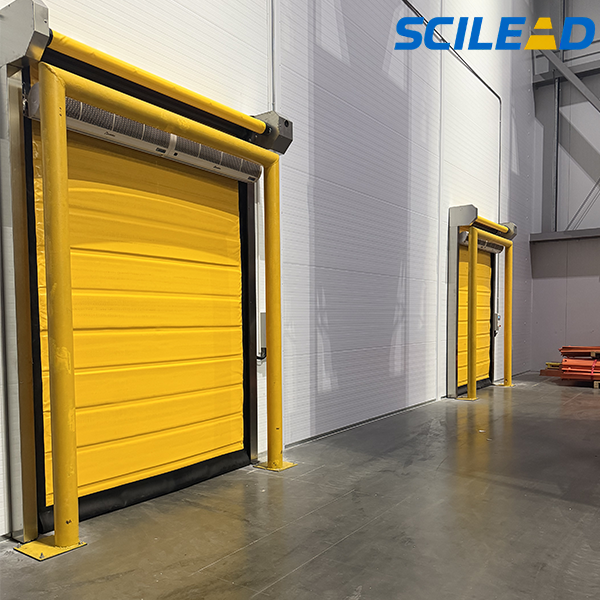
5 Key Factors When Choosing an Industrial Roller Shutter Door
Operating Frequency and Daily Traffic
Buyers should confirm the expected operating cycles per day, peak-hour traffic volume, and motor duty rating with the manufacturer before selecting a door system.
It is common for warehouses and other industrial buildings to have different entrances. A warehouse entrance which is only occasionally passed by vehicles differs significantly from a production area that is constantly moved about in by forklifts.
Even when two doors are of equal size, their expected number of cycles and their mechanical performance requirements may deviate greatly from one another. When selecting a door, the load capacity of the motor and the doors’ cycle frequency must be checked.
Think about it: in a busy area like a loading and unloading zone, where forklifts frequently travel back and forth between the warehouse and the production area, wouldn’t a slow-opening roller door cause congestion? However, the fastest speed isn’t necessarily the best solution. The door must also feature controlled closing functionality, reliable safety detection mechanisms, and sufficient durability to withstand frequent operation.
Door Dimensions and Structural Requirements
The opening size affects the structure of the door. For example,very wide doors or very high doors require consideration of the load of the door curtain, the bearing power of the guide rails, the design of the roller and the motor power.The impact of wind pressure has to be considered for outdoor applications as well. In open areas and changeable weather conditions with strong winds also during the seasons wind pressure has to be taken into account. Wind resistance is determined by the complete door assembly, including curtain profiles, guide rails, reinforcement components, and mounting structure.
Providing accurate opening dimensions and on-site conditions enables our factory to recommend suitable configuration options instead of solely offering standardized products.
Environmental Conditions and Insulation Needs
The application in which a curtain is installed plays a significant role in choosing the most suitable material and slat construction.A roller shutter door installed outside a warehouse could require additional protection against weather where as a door installed inside a temperature controlled environment might require better thermal insulation.
Different slat configurations offer different levels of protection and performance. The following table outlines common options and their typical applications.
| Slat Type | Main Characteristics | Recommended Applications |
| Single-Skin Steel Slats | Rigid construction, suitable for general security and everyday use | Warehouses, workshops, and industrial entrances |
| Double-Skin Insulated Slats | Insulating core helps reduce heat transfer and improve temperature separation | Temperature-controlled warehouses and facilities |
| Aluminum Slats | Lightweight structure with good corrosion resistance, depending on the finish | Commercial facilities and environments requiring lighter door construction |
| Perforated Slats | Allow partial visibility and airflow while maintaining a physical barrier | Retail storage areas, parking facilities, and ventilation-sensitive spaces |
| Reinforced Steel Slats | Reinforced profiles designed to improve curtain rigidity | Paired with matching guides and mounting structures to deliver improved wind load resistance. |
Beyond slat selection, buyers should also evaluate surface coatings, corrosion protection, and perimeter sealing. For facilities exposed to moisture, chemicals, or frequent cleaning, the material and finish should be matched to the actual exposure conditions.
For temperature-sensitive applications, insulated slats combined with appropriate side and bottom seals can help reduce unwanted heat exchange. However, the overall insulation performance also depends on installation quality and the sealing design, not just the curtain structure.
Safety Devices and Control Integration
Industrial roller shutter doors often operate alongside forklifts, pedestrians, and automated material-handling systems.
Therefore consideration of safety aspects has to take place before installation.As an option depending on the application of the door, a roller shutter can be fitted with for example a photocell, safety edges,warning lights or even a manual emergency operation.This door can also be integrated with controlled access systems,such as access control systems, push-button stations, etc.The goal is to integrate door operation with the traffic control and safety of a facility.
While specific safety devices may vary depending on the installation environment, safety requirements should always be considered during the initial door specification stage.
Maintenance Accessibility and Total Operating Cost
The initial purchase price of an industrial roll-up door does not reflect its total cost of ownership. Subsequent motor replacements, wear and tear on parts, maintenance labor costs, and production downtime caused by malfunctions will all continue to affect the equipment’s long-term value.
When purchasing doors, prior to placing the order, it is necessary to clarify the expected service life of main parts and components, availability of spare parts, regular maintenance and technical support offered by the manufacturer.When choosing a model prioritize drive components that are easy to maintain and for which a maintenance plan exists. It is helpful to keep a copy of the recommended spare parts list handy and to always maintain a sufficient stock of the wear-and-tear parts in order to minimize waiting time in case of an unexpected breakdown.
For factory facilities where entrances and exits directly support production and logistics, minimizing downtime losses is typically more important than simply pursuing the lowest purchase price. Models can be selected based on the importance of each passageway: choose high-cycle models for primary logistics routes and consider economical solutions for secondary entrances and exits.
Frequently Asked Questions About Industrial Roller Shutter Doors
Find practical answers to common questions about industrial roller shutter door specifications, materials, performance, and purchasing requirements.
1. What specifications should I provide when ordering an industrial roller shutter door?
When requesting a quotation for an industrial roller shutter door, provide the opening width and height, installation environment, expected operating cycles per day, and required control functions. For outdoor installations, also describe the site’s wind exposure. If insulation or corrosion protection is required, specify the environmental conditions. These details help the manufacturer recommend suitable curtain materials, guide rails, motor capacity, and safety configurations.
2. How do I choose an industrial roller shutter door for a warehouse?
Choosing an industrial roller shutter door for a warehouse depends on traffic volume, opening dimensions, security requirements, and environmental conditions. Main logistics entrances with frequent forklift movements may require a higher-cycle motor and reliable safety detection systems. Secondary entrances with limited traffic may use a more economical configuration. Consider the actual function of each doorway rather than selecting every door based on the same specifications.
3. Are insulated roller shutter doors suitable for temperature-controlled facilities?
Yes. Insulated industrial roller shutter doors are suitable for applications where reducing heat transfer between adjacent areas is important. Double-skin insulated slats can help improve temperature separation in temperature-controlled warehouses and industrial facilities. For better overall performance, buyers should also evaluate side seals, bottom seals, and installation quality, as insulation depends on the complete door system rather than the curtain alone.
4. What type of industrial roller shutter door is suitable for high-wind areas?
For facilities exposed to strong winds, consider industrial roller shutter doors with reinforced steel slats, compatible heavy-duty guide rails, and suitable mounting structures. Wind resistance depends on the complete door assembly, including curtain profiles and reinforcement components. Before purchasing, provide the manufacturer with the door dimensions and site wind conditions so the appropriate structural configuration can be evaluated.
5. Can industrial roller shutter doors handle frequent daily operation?
Yes, provided the door system is selected according to its expected operating frequency. For busy warehouses and production facilities, buyers should confirm the motor duty rating, expected operating cycles, and component durability with the manufacturer. A high-cycle configuration is particularly important for entrances serving continuous forklift and material-handling traffic. Controlled closing and appropriate safety detection should also be considered.
6. What should buyers look for in an industrial roller shutter door manufacturer?
Buyers should evaluate a manufacturer’s ability to recommend suitable door configurations based on actual project conditions. Important considerations include technical specifications, available slat options, motor configurations, safety systems, spare parts availability, maintenance requirements, and after-sales technical support. Working with an experienced industrial roller shutter door manufacturer can help ensure the selected system meets the facility’s operational and long-term maintenance requirements.