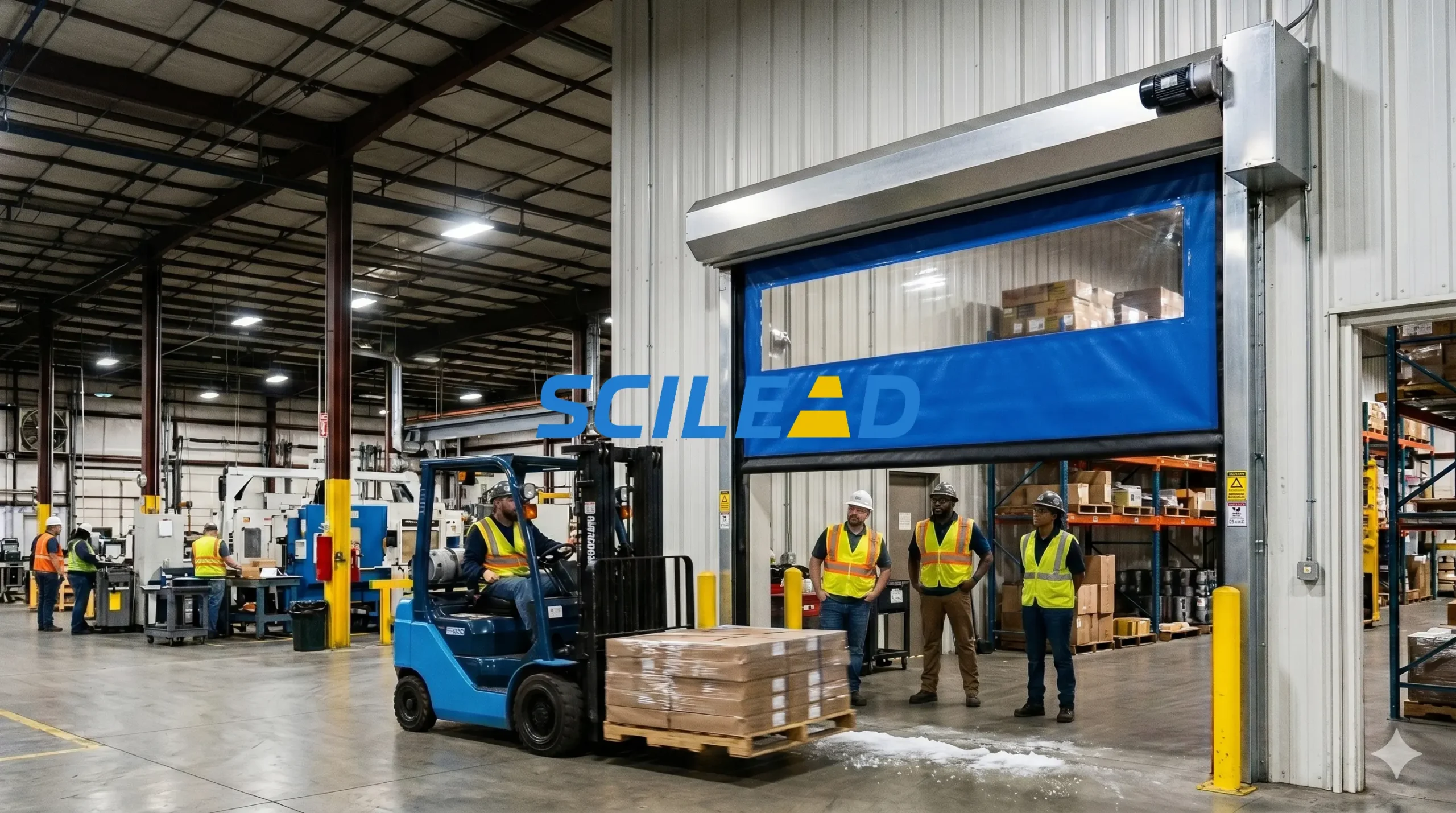
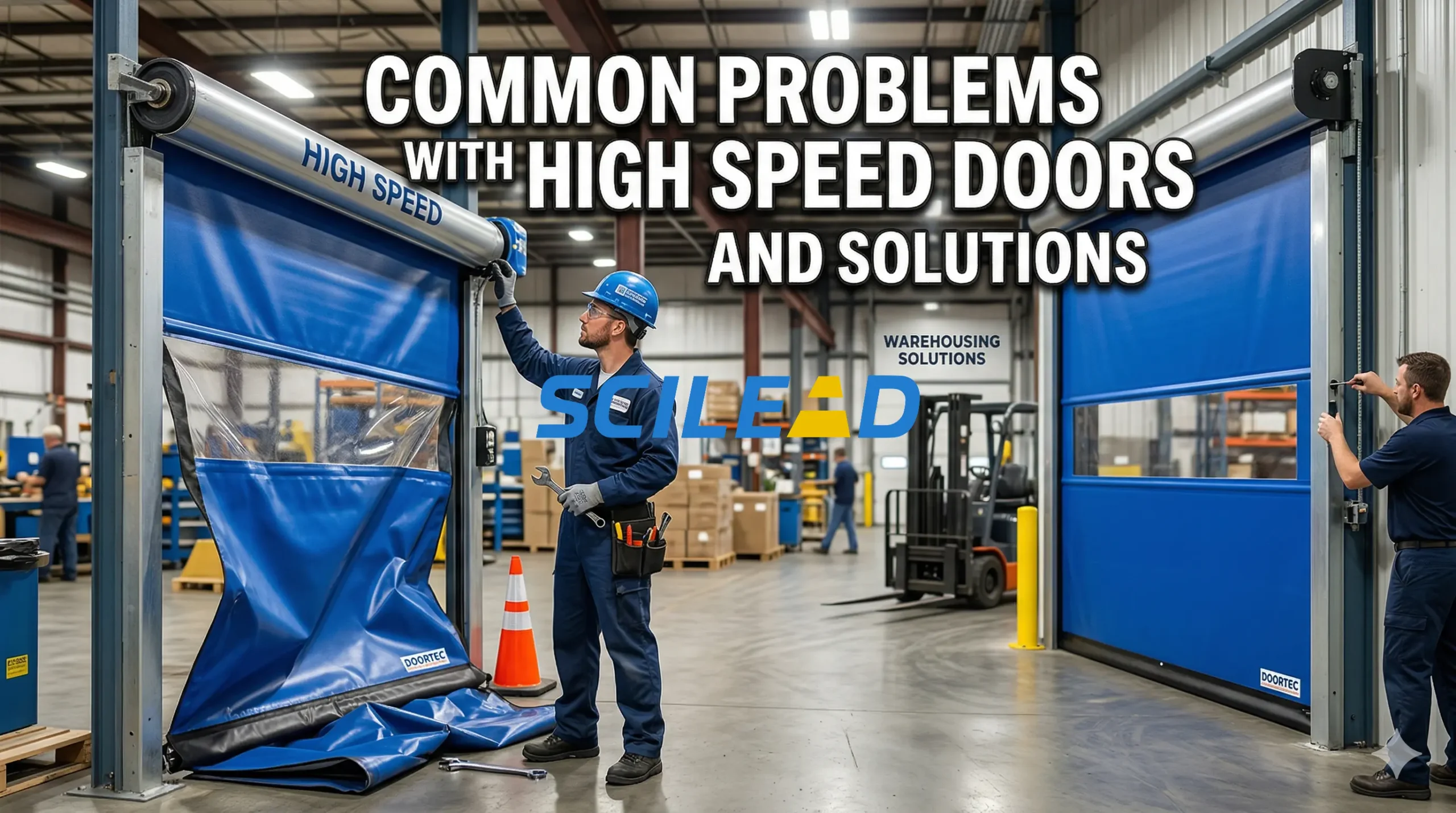
A roll up high speed door is a fast-operating industrial door designed to open vertically and roll into a compact housing above the doorway. It is widely used in factories, warehouses, cold chain facilities, cleanrooms, and logistics passages where speed, efficiency, and environmental control matter.
Table of Contents
- What Is a Roll Up High Speed Door?
- How Does a Roll Up High Speed Door Work?
- Main Benefits of Roll Up High Speed Doors
- Common Applications
- Roll Up High Speed Door vs. Other Industrial Doors
- What to Consider Before Buying
- Why Choose SCILEAD
- FAQ
What Is a Roll Up High Speed Door?
A roll up high speed door is an industrial door that opens and closes at a much higher speed than a conventional rolling shutter or sectional door. The curtain usually moves upward along side guides and rolls around a shaft or into a top drum. Because the opening cycle is fast, a roll up high speed door helps reduce air exchange, improve traffic flow, and limit dust, insects, and temperature loss.
Depending on the application, the door curtain may be made of flexible PVC or more rigid materials. In many industrial settings, a roll up high speed door is selected for frequent daily operation, low maintenance needs, and efficient separation between work areas.
How Does a Roll Up High Speed Door Work?
A roll up high speed door typically uses a motor, control system, guide tracks, and safety sensors. When triggered by a push button, radar, remote control, pull cord, loop detector, or access control system, the motor lifts the door curtain upward at high speed. After vehicles or staff pass through, the door closes automatically.
The system is designed for frequent cycles. A standard roll up high speed door often includes photocells, safety edges, and obstacle detection to reduce collision risk. Some models also include self-repairing functions, which allow the curtain to reset after accidental impact.
Main Benefits of Roll Up High Speed Doors
The main reason companies install a roll up high speed door is operational efficiency. Fast opening and closing improves traffic movement and reduces waiting time for forklifts, pallets, and personnel. In busy facilities, this can support smoother workflows.
Another key benefit is environmental control. A roll up high speed door helps limit the movement of outside air, dust, humidity, and insects into controlled areas. This is especially useful in food production, pharmaceuticals, electronics, and clean manufacturing.
Energy efficiency is also important. Because the door remains open for a shorter time, conditioned indoor air is better retained. This can help reduce heating or cooling loss in temperature-sensitive facilities.
In addition, a roll up high speed door can improve cleanliness, visibility, and workplace safety when matched with the right control system and traffic pattern.
Common Applications
A roll up high speed door is commonly used in internal and external industrial openings. Typical applications include warehouses, logistics corridors, production workshops, cold storage transitions, and clean areas.
In logistics facilities, the door supports faster goods movement and helps separate zones with different traffic intensity.
Where stronger wind load resistance is required, a standard flexible roll up high speed door may need to be upgraded to a reinforced model. If a project requires more rigid structure, a metal spiral high-speed door may be a better fit.
Roll Up High Speed Door vs. Other Industrial Doors
A roll up high speed door is not the same as a standard rolling shutter. Traditional rolling shutters are usually slower and are often chosen for security closure rather than frequent traffic flow. In contrast, a roll up high speed door is built for repeated daily cycles and faster access.
Compared with sectional doors, a roll up high speed door usually takes less time to open and close and is more suitable for process separation. Compared with spiral doors, flexible roll up doors are often more economical, while spiral doors may offer stronger rigidity, better insulation options, and higher resistance in demanding external conditions.
The best choice depends on opening size, frequency of use, wind pressure, temperature control needs, and safety requirements.
What to Consider Before Buying
Before choosing a roll up high speed door, start with the application. Is the door installed indoors or outdoors? Does the opening require insulation, cleanroom performance, wind resistance, or high cycle frequency? These questions affect the correct configuration.
You should also evaluate door size, traffic type, opening speed, safety devices, and control options. Facilities with forklifts may require radar or loop detection. Hygiene-sensitive zones may need smooth surfaces and better sealing. Outdoor openings may require stronger frame design and reinforced curtain structure.
Maintenance support matters as well. A roll up high speed door works best when spare parts, technical guidance, and after-sales service are available. For project consultation, visit SCILEAD Contact Us.
Why Choose SCILEAD
SCILEAD focuses on industrial high speed door solutions for a range of operational needs, including cleanroom, cold chain, logistics, and wind-resistant applications. This makes it easier for buyers to compare a standard roll up high speed door with other door systems in one place.
If you are evaluating specifications, application fit, or project requirements, you can begin from the SCILEAD homepage or browse the full SCILEAD blog for more buying and application guides.
FAQ
Is a roll up high speed door suitable for outdoor use?
Yes, but outdoor use depends on wind load, sealing requirements, and structure. In demanding exterior conditions, reinforced or wind-resistant models are usually preferred.
What is the main advantage of a roll up high speed door?
The main advantage is fast operation, which improves traffic efficiency while reducing air loss, dust entry, and energy waste.
Can a roll up high speed door help reduce energy costs?
Yes. Because the door opens and closes quickly, it can reduce the transfer of conditioned air between spaces, especially in climate-controlled environments.
How is a roll up high speed door different from a spiral door?
A roll up high speed door usually uses a flexible curtain, while a spiral door generally uses rigid panels and is often selected for higher structural strength and premium performance.