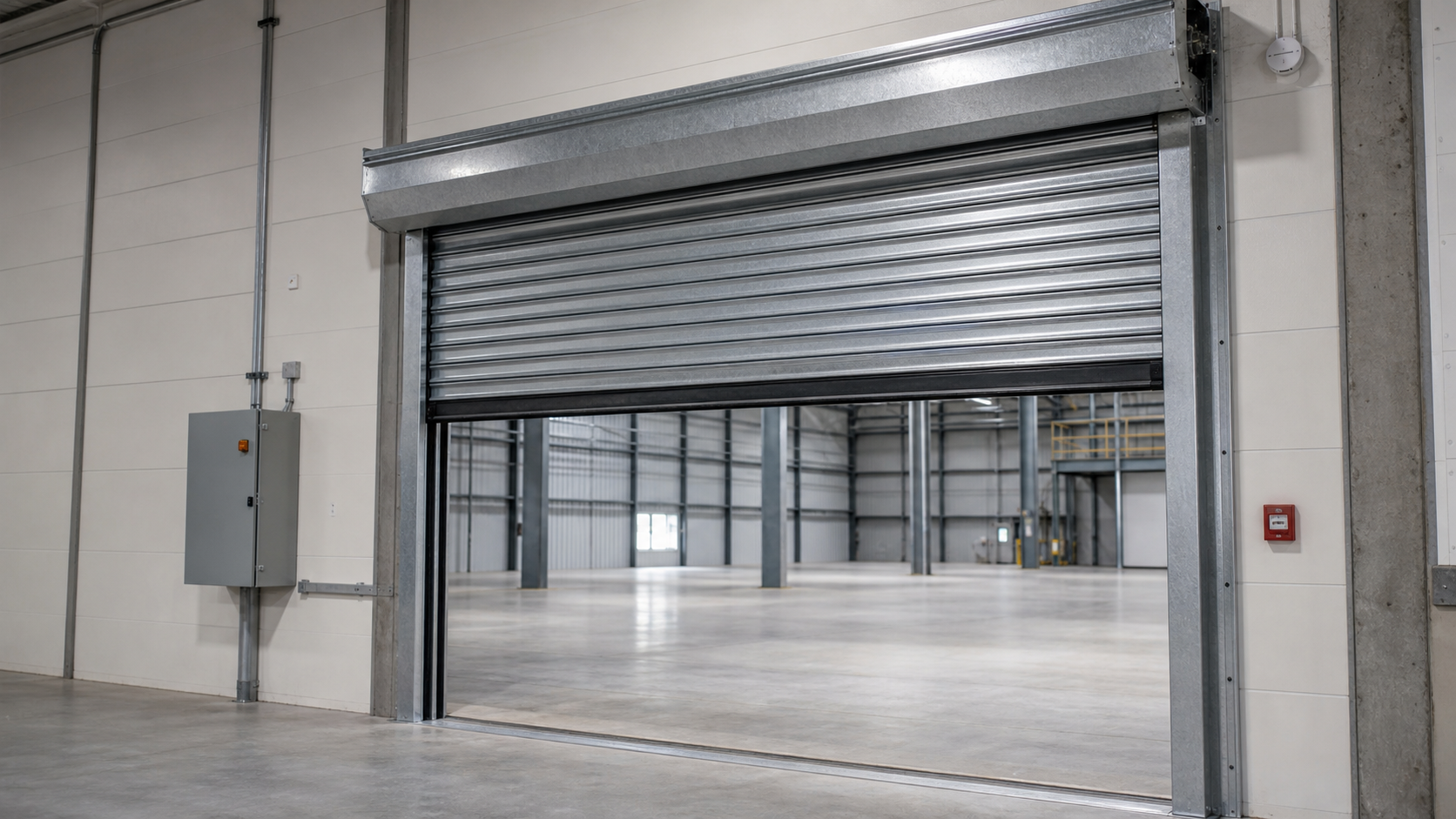
An industrial door is more than just a matter of size, color and operation. In warehouses, production plants, cold stores, clean rooms and distribution centers, the choice of door can have a significant effect on issues such as productivity, energy consumption, safety and the environment.The question is therefore not “Which industrial door is the best?” but rather:Which type of industrial door is best suited to the operating conditions, traffic frequency, environmental requirements, and safety standards of the facility?
There are many types of industrial doors available in the market.The range of industrial doors available on the market today includes: high-speed doors, industrial roller shutter doors, spiral doors and many other specialized doors.
This guide explains 3 major industrial door types for warehouses and manufacturing facilities——where they are used, why buyers choose them, and what operating conditions should drive the decision.
High-Speed vs Roller Shutter vs Spiral Doors
| Factor | High-Speed Door | Industrial Roller Shutter | Spiral Door |
|---|---|---|---|
| Opening speed | Very fast | Moderate | Very fast |
| Traffic frequency | High | Low–medium | High |
| Wind resistance | Low–medium | High | High |
| Impact resistance | Moderate | High | High |
| Insulation | Good | Depends on design | Excellent |
| Sealing | Good | Moderate–good | Excellent |
| Outdoor use | Depends on model | Yes | Excellent |
| Space requirement | Low | Low | Very low |
| Automation | Excellent | Good | Excellent |
| Best for | High traffic | Security & protection | High traffic + outdoor |
| Typical application | Warehouse, production | Factory, warehouse | Logistics, factory, loading dock |
High-speed doors
Where and Why Are High-Speed Doors Used?
High-speed doors are commonly used in large factories, logistics warehouses, cold storage rooms and fresh food supermarkets.High-speed doors are able to open and close at ultra-fast speed,perform frequent opening and closing, and effectively isolate the environment of automated production lines.
Designed for high-intensity use throughout the day. As an “invisible working barrier”, they enable forklifts, AGVs, pedestrians and other vehicles to pass through doors whilst keeping out dirt, flies, noise and hot/cold air.
The doors are particularly suited for use in 24/7 sorting centers and warehouses. The fast opening and closing of high-speed doors saves time and cuts energy consumption.Because they open and close quickly, waiting time for vehicles as well as pedestrians is kept to a minimum. High-speed doors are often installed in food processing, pharmaceutical, precision-electronics and automotive workshops in order to prevent the penetration of dust and insects whilst maintaining room temperature and humidity and preventing the spread of odors in order to create clean rooms and meet the highest standards of hygiene.
For cold-chain cold-storage applications, specialized cold-room high-speed doors are often designed to function reliably in sub-zero environments to prevent cold air loss and to minimize the risk of condensation and ice forming.In addition to typical industrial and commercial applications,high-speed doors are also often used at supermarkets, shopping malls, and underground car parks.They separate temperature zones and enable a smooth flow of people and vehicles. These rapid action doors are also suitable for use at special sites,
such as disinfection tunnels and in explosion-proof chemical areas.Fitted with radar induction, ground-loop sensors or infrared light curtains open automatically for approaching traffic and stop-rebound in case of obstacles while closing.
When Is a High-Speed Door Not the Best Choice?
We have covered the key benefit of high‑speed doors: fast opening and closing.
If your door opening does not get heavy traffic, standard roller shutters or regular doors can work well. Installing higher‑cost high‑speed doors will not make good economic sense in this case.
No special needs for insulation or cleanliness
If your site does not require strict control over temperature, humidity, dust or insect prevention, a high‑speed door will not deliver much extra value.
Higher price point
High-speed doors come with higher upfront installation and integration costs. Even though they are built for long service life, these precision automatic machines often cost more to maintain and repair than simpler basic doors. Think carefully if you work with a limited budget.
Space-related limitations
High-speed doors have relatively low requirements for floor conditions. Still, some models need pre-installed guide rails, which increases construction work. For extra large door openings, you need reinforced building structures. These custom jobs mean longer lead times and much higher costs. Some suppliers may decline these custom orders.
Industrial Roller Shutter Doors
Where and Why Are Industrial Roller Shutter Doors Used?
Industrial roller shutters are widely installed in factories, workshops, warehouses, logistics centers, shopping malls and underground parking garages. Many buyers confuse them with high-speed industrial doors.
While high-speed doors are primarily designed to open and close quickly for frequent passage of people and goods, temperature separation and automated production lines. Industrial roller shutters are designed to protect, provide fire separation and save space with very wide doors. Often used in manufacturing plants, storage depots, clean workshops and cold store warehouses, these shutters typically run up within guides
at the top of the door,thus not occupying valuable side or internal space.Solidly constructed, they resist wind and absorb impacts from accidental forklift contact. In clean workshops (food, pharmaceuticals, electronics) made to clean surfaces, made of PVC or PVDF, roller curtains keep dust, insects and air out of the area and fulfill the GMP requirements.Insulated roller shutters can be used in cold-chain warehouses as well as coastal sites. Roller shutters made of stainless steel achieve anti-corrosion performance in harsh sea wind and sand.
Fire-rated roller shutters are required by fire regulation to form part of the overall fire safety solution to contain fire and smoke until safely evacuated.They are also applied for commercial facilities and private garage entrances with automatic sensor-triggered opening and anti-theft features.
Compared with fast-moving high-speed doors, industrial roller shutters run at a lower travel speed yet provide superior structural strength and wind-load capacity. Fire-rated roller shutters cannot be replaced by high-speed doors for fire zoning purposes. Reliable durability, energy efficiency, safety features and flexible customization of industrial roller shutters meet the varied requirements for entries and exits to modern industrial and commercial buildings.
If your facility requires specialized environmental control, such as cold storage, cleanroom production or machine protection, see our guide to Industrial Doors for Cold Storage, Cleanrooms and Automated Manufacturing.
When Is a Industrial Roller Shutter Door Not the Best Choice?
High-frequency logistics traffic areas
Typical industrial roller shutters open and close slowly. Where forklifts and trucks frequently pass through the logistics gates of a workshop, such doors can become a bottleneck and impede material flow.
Most roller shutters have wide gaps between slats which will allow sand, dust, rain and even insects to enter the workshop.Their single-layer metal panels are not insulated. This means that the indoor temperature does not stay constant and generates high costs for heating and cooling. Thus they are unsuitable for cleanrooms, food workshops and pharmaceutical work spaces as well as for cold storage.
Special workshops with fire and explosion risks
In workshops with lithium-battery, spraying and fine-chemicals flammable gases or even conductive dusts can be found. Electric arcs are also generated by the motor of a roller-shutter. Static sparks can be produced by metal-to-metal contacts. Industrial roller shutters normally open and close slowly Without explosion-proof features, these doors may trigger explosions. Professional explosion-resistant roller shutters are required here.
Extra-large openings or strong wind-pressure sites
Roller shutters have limited wind-resistance. For very wide openings or extreme high-wind areas, slats may bend, jam or fall off the track. Heavy-duty stacking doors work better.
Emergency evacuation or fire exits
Due to fire safety codes, roller shutters cannot be opened as evacuation doors. After a power failure, they will not automatically open and thus may even block escape routes.
Spiral Doors
Where and Why Are Spiral Doors Used?
Spiral doors, also referred to as industrial spiral doors, hard high-speed spiral doors, or turbine hard rapid doors, are special industrial doors. They are a combination of the high-speed door with very fast opening and closing times and industrial metal roller shutters with very high load capacity.There are a lot of misunderstandings of spiral doors with soft-curtain high-speed doors and industrial roller shutters. Although soft-curtain high-speed doors can provide fast entry-exit, they are not suitable for outdoor use due to weak wind load resistance and poor rigidity;roller shutters have solid protection but open slowly. Industrial spiral doors offer the perfect balance of high speed operation, a strong metal structure, tight seals and outdoor use. For industrial entrances that require a higher level of quality, industrial spiral doors are an upgraded premium product.
Industrial spiral doors are widely applied in logistics distribution centers, large warehouses, loading docks, airport freight terminals, cold chain warehouses, food workshops, pharmaceutical clean workshops, automobile manufacturing plants and entrance areas with limited space.This fast opening and closing door supports hundreds to thousands of high frequency opening and closing operations per day, saving waiting time for forklifts and trucks.The door panels travel along a unique friction-free spiral track in the spiral lifting door’s special design. Without touching each other during operation, the panels move quietly and stably.As a low-wear product, it enables operation over more than 1million cycles, far exceeding the service life of fast doors of conventional design.
Spiral doors are made of double-layer aluminum alloy or color steel plates filled with high-density PUF foam and equipped with a thermal break insulation structure. The doors are capable of blocking internal and external cold and hot air convection, maintaining constant indoor temperature and and reducing refrigeration and air conditioning energy consumption.Spiral doors are installed with multi-layer sealing strips to panel gaps and door edges to achieve superior dust-proof, insect-proof
and odor-isolating functions, which meet the GMP clean standards for food, pharmaceutical and other precision manufacturing workshops.Compared with the soft-curtain type high-speed door that can only be used indoors, the metal door panels of the spiral door have strong wind load up to wind load category 12 and anti-theft function. They can be used in outdoor environments such as coastal factories and open workshops with strong winds.
With a compact vertical spiral structure, the door occupies minimal overhead space. It supports circular, oval and low-lintel spiral rail solutions to maximize effective passage height, solving the installation difficulties of low-door-head and space-limited sites such as underground garages and multi-story parking lots. In terms of safety, industrial spiral doors are equipped with infrared safety photoelectric sensors, bottom safety airbags and light curtains. The door body can stop and rebound automatically within 0.1 to 0.3 seconds once obstacles are detected during descent, effectively preventing personnel injury and equipment collision accidents for mixed pedestrian and AGV traffic passages.
Compared with traditional industrial roller shutters and soft-curtain high-speed doors, industrial spiral doors integrate the advantages of both product lines while overcoming their common drawbacks of slow speed, poor sealing, short service life and weak outdoor adaptability. Featuring high speed, stable operation, excellent thermal insulation, strong wind resistance and ultra-long durability, industrial spiral doors have become the ideal high-end entrance and exit solution for modern smart logistics and high-efficiency factories.
When Is a Spiral Door Not the Best Choice?
Spiral doors have many benefits, but they are not a one-size-fits-all solution. They are not the best option under these conditions:
Used as fire evacuation doors or fire zone dividers
This is the key restricted application for spiral doors. Spiral doors have no fire-retardant rating and cannot pass fire certification. They cannot stop fire spread during an emergency. If power fails or the door breaks down, it may block people from escaping.
Tight-budget sites with low performance requirements
The structure of a Spiral door consists of aluminum alloy foam panels, twin spiral tracks and servo control systems. These components increase the cost of production and installation.A simple division of indoor areas with no requirements for thermal insulation, wind resistance or seal ability can be better realized with high-speed roller shutters or simple industrial roller shutters.
Locations with very limited overhead installation space
Spiral doors rely on special turbine-style spiral guide rails. The door panels roll along curved tracks for storage. Enough overhead space above the doorway for the turbine housing is mandatory. Installation is impossible if the lintel area is too narrow.
Extra-large door openings or extremely harsh working conditions
While spiral doors can reach up to Wind Class 10-12, the detail of the panels and the frame does not reach the same standard as heavy-duty stacking doors for very wide openings (dozens of meters) and will often require heavy custom reinforcement to achieve permanent strong wind or corrosive environments.
Low-cycle openings without high-efficiency separation needs
Spiral doors are designed for frequent vehicle and pedestrian traffic. Fast opening-closing cuts air exchange to save energy and keep cleanliness. If the door only opens a few times each day, its core advantages go unused. Standard door types will work sufficiently.
FAQ
Industrial Doors FAQ
Common questions regarding industrial door types, selections, and applications.