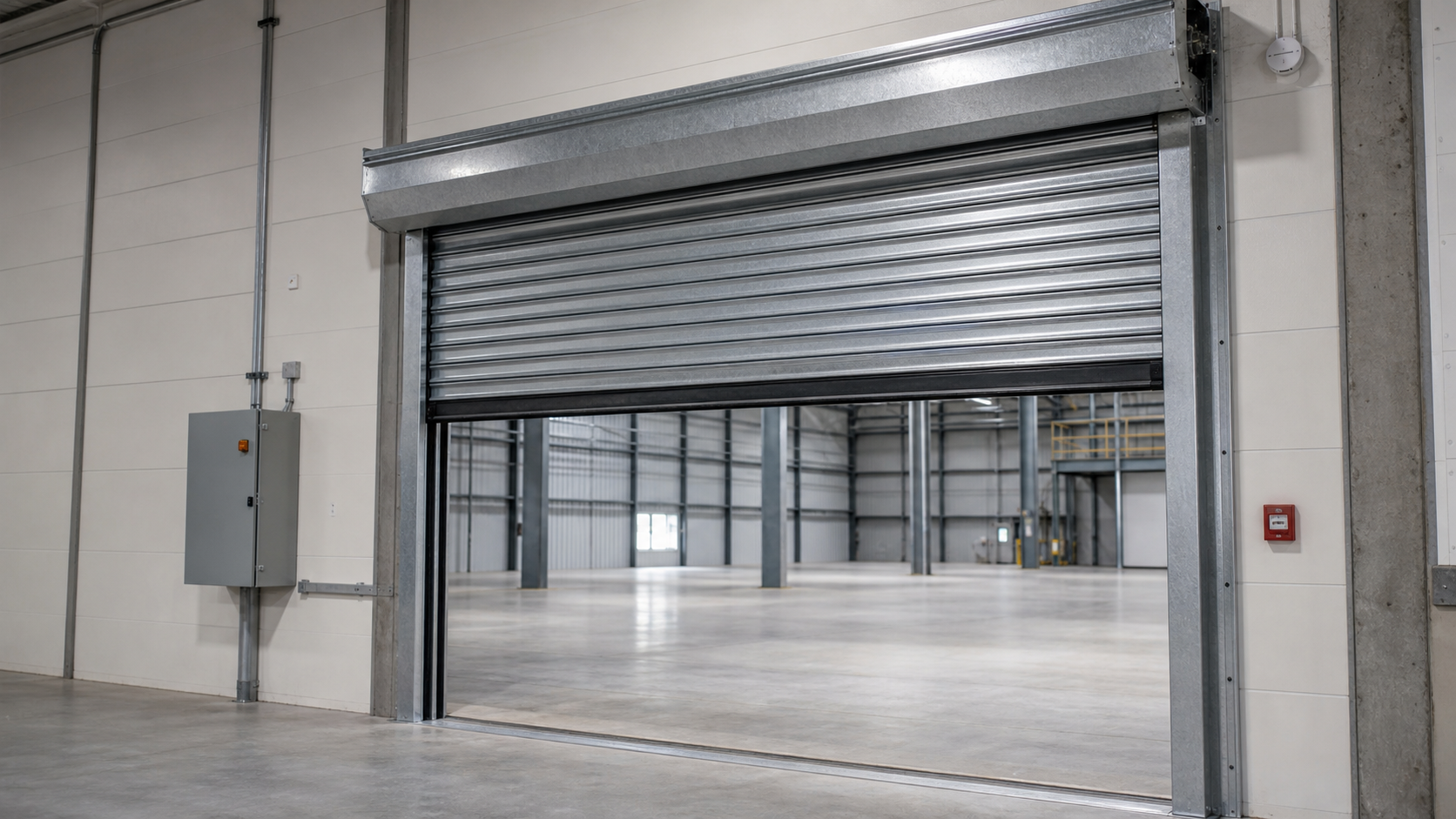
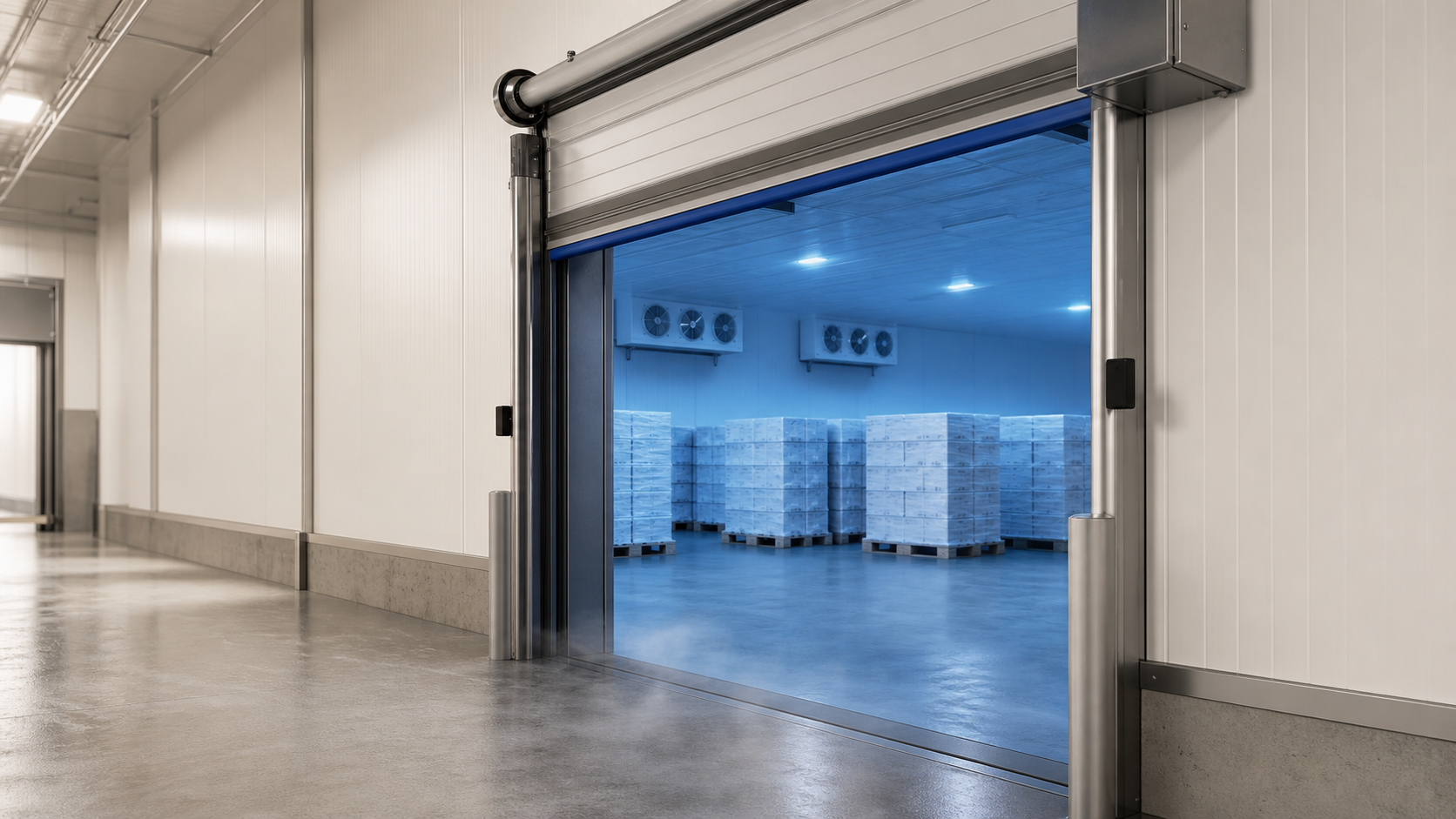
A fast roll-up door is not automatically a fire-rated door. For an opening in a fire-resistance-rated wall, the facility team must verify a listed fire door assembly whose rating, components, closing method, installation, and inspection program match the adopted code and the authority having jurisdiction (AHJ). The 2025 edition of NFPA 80 is the current national standard for fire doors and other opening protectives, while the 2024 International Building Code (IBC) provides model-code requirements for where rated opening protectives are used. Local adoption may follow an earlier edition, so the project must identify its jurisdiction before procurement.
This distinction matters when buyers search for fire rated high speed roll up doors. Operating speed may improve traffic flow, but it does not establish a fire-protection rating. The correct buying task is to coordinate the wall, opening, complete listed assembly, controls, egress strategy, and lifecycle testing—not to add a fire-related option to an ordinary rapid door.
Start with the wall, not the door speed
First determine whether the opening is in a fire wall, fire barrier, fire partition, smoke barrier, or an unrated separation. Obtain the life-safety plans, door schedule, wall rating, occupancy information, and applicable code edition. The required opening protection is derived from that context.
DASMA Technical Data Sheet 458 explains that high-speed doors are typically non-fire-rated and therefore should ordinarily be installed only in non-fire-rated walls. Its guidance also says any proposed use as an egress component requires AHJ approval. That does not mean a fast-operating rated assembly is impossible; it means the buyer must verify the specific tested and listed assembly rather than infer performance from the words “high speed.”
If the opening is unrated, a conventional high-speed door may be appropriate for workflow, environmental separation, or machine traffic. SCILEAD’s steel galvanized industrial door series and other product families can be evaluated for operational needs, but no product should be treated as fire-rated unless the exact supplied assembly carries the required evidence for the project.
What the 2024 IBC framework means for roll-up fire doors
IBC 2024 Section 716 addresses opening protectives. For rolling steel fire doors and several other non-swinging assemblies, Section 716.2.1.2 points to testing in accordance with NFPA 252 or UL 10B. The required rating still depends on the surrounding assembly and the adopted local code. A model code is not itself proof that a particular door complies.
UL’s application guide reinforces the assembly approach. It identifies rolling steel fire doors under UL category GSVV and associates that category with UL 10B. It separately lists fire-door frames, operators, hardware, gasketing, smoke-leakage assemblies, and other components. Buyers should therefore review the certification record and installation instructions for the complete configuration. A labeled curtain paired with an unapproved operator, guide, release device, or field modification may no longer represent the investigated assembly.
Do not substitute a product brochure for the listing
Request documentation that identifies the manufacturer, model, certification or listing organization, fire-protection rating, maximum listed size, mounting arrangement, guides, hood, bottom bar, operator, automatic-closing or release equipment, and permitted options. Verify the record in the certification body’s database when available. Marketing phrases such as “fire resistant,” “fireproof material,” or “suitable for fire walls” are not equivalent to a traceable listing for the supplied opening.
Seven checks for fire-rated high-speed roll-up doors
| Check | Evidence to request | Why it matters |
|---|---|---|
| 1. Jurisdiction | Adopted building/fire code editions and AHJ contact | Edition and local amendments control the project |
| 2. Barrier | Rated wall type, rating, opening schedule, and approved plans | The opening requirement begins with the surrounding construction |
| 3. Listing | Current certification record and label details | Proves the tested scope of the specific assembly |
| 4. Configuration | Approved drawings, size, mounting, guides, operator, release, and accessories | Unlisted substitutions can change performance |
| 5. Closing logic | Cause-and-effect matrix for alarm, detector, fusible link, power loss, obstruction, and reset | The door must reach its protective position as designed |
| 6. Egress | Code-approved pedestrian egress plan and signage | A vehicle or material door is not automatically an acceptable exit |
| 7. Lifecycle | Acceptance test, inspection instructions, service access, records, and responsible party | Protection depends on ongoing operability, not purchase-day paperwork |
Coordinate speed with automatic closing and entrapment protection
Normal traffic operation and fire-mode operation are different functions. The sequence should state what initiates closing, whether the operator changes speed or mode, how safety devices behave, what happens after an obstruction, and who may reset the system. Do not assume a normal photocell or presence sensor can simply prevent closure indefinitely during a fire event. The approved control philosophy must reconcile life safety, entrapment protection, and the listed fire-closing function.
UL identifies fire-door operator categories evaluated to UL 228 and, for certain operator categories, UL 325. This does not mean any UL 325 door operator can be attached to any rolling fire door. Verify the operator and controls as part of the listed or approved system and follow the manufacturer’s installation instructions.
Commission the complete cause-and-effect sequence with the fire-alarm contractor, door supplier, controls integrator, and facility representative. Record the test result for alarm input, local initiating devices where applicable, power interruption, backup power if provided, obstruction, full closure, reset, and restoration to normal service.
Keep pedestrian egress separate unless specifically approved
A high-speed opening used by forklifts or materials should not be assumed to provide compliant pedestrian egress. DASMA’s egress guidance says high-speed doors do not meet a strict egress definition by default and describes possible approaches that still require AHJ review. The safest early design decision is often to provide a separate compliant personnel door where the code and layout require one.
If the project proposes the roll-up door as an egress component, document occupant load, occupancy, opening dimensions, manual release or breakout behavior, backup power where proposed, signage, accessibility, and failure response. Obtain written approval before equipment is ordered. Do not leave that decision to field commissioning.
Plan inspection and testing before purchase
NFPA’s April 11, 2025 fire-door FAQ states that NFPA 80 requires inspection and testing immediately after initial installation and at least annually afterward. It also says the work must be completed by a qualified person with knowledge of the relevant door and operating components, subject to AHJ acceptance. For rolling fire doors, the maintenance plan should address the applicable operational or drop testing, reset, labels, guides, curtain, release components, and records required by the adopted edition and manufacturer.
Add these deliverables to the purchase order:
- approved shop drawings and certification/listing references;
- installation, operation, inspection, testing, and maintenance instructions;
- fire-alarm and controls interface drawings;
- initial inspection and functional test reports;
- training for authorized facility personnel;
- a defined annual inspection owner and service scope;
- a process for reviewing repairs or field modifications before work begins.
A maintenance contract is useful only when it identifies the exact assembly, qualified service scope, test procedure, documentation, and escalation route for deficiencies. Generic “door service” is not enough for an opening protective.
Common specification errors to reject
- Choosing by speed first: establish the rated-opening requirement and listing before optimizing cycles or traffic flow.
- Accepting component-level evidence: a motor, curtain material, detector, or controller certification does not certify the complete door assembly.
- Mixing unverified options: windows, controls, seals, finishes, locks, and field-drilled attachments must be permitted by the listing and instructions.
- Ignoring local adoption: NFPA 80-2025 and IBC 2024 are current publications, but the AHJ may enforce different editions or amendments.
- Skipping lifecycle planning: access for testing, documentation, reset procedures, and annual inspection responsibilities must exist from day one.
How SCILEAD can support the early specification
SCILEAD can help facility teams define opening size, traffic, cycle demand, controls interfaces, environmental separation, and installation constraints. Review the industrial door product center for operational door families and the high-speed door certification guide for broader supplier-document questions.
For a rated opening, final selection must be based on the specific assembly’s traceable certification, the adopted jurisdictional requirements, approved construction documents, and AHJ acceptance. Share the wall schedule, opening details, required rating, traffic pattern, and control narrative when you contact SCILEAD for a technical review. If SCILEAD does not offer an assembly matching the required listing and configuration, a separately sourced listed fire door is the appropriate solution.
Frequently Asked Questions
Are all high-speed roll-up doors fire-rated?
No. High operating speed does not establish a fire-protection rating. The specific complete assembly must be tested, listed, labeled, installed, and maintained for the required opening and jurisdiction.
Can a standard high-speed door be installed in a fire-rated wall?
Generally, an opening in a rated wall needs the opening protection required by the adopted code. Do not place a typical non-rated high-speed door there unless the approved design and AHJ expressly allow it.
Which standards apply to rolling steel fire doors in the United States?
The adopted building and fire codes establish the legal requirements. IBC 2024 Section 716 references NFPA 252 or UL 10B for rolling steel fire-door assembly testing, while NFPA 80 covers installation, inspection, testing, and maintenance. Confirm the editions and amendments adopted locally.
Does UL 325 make a roll-up door fire-rated?
No. UL 325 addresses safety for door, gate, and window operators and systems. Fire-door performance requires the applicable fire-door assembly evidence, and the operator must be permitted for that configuration.
How often should a rolling fire door be inspected?
NFPA’s 2025 guidance states that fire doors are inspected and tested after initial installation and at least annually thereafter. Follow the adopted NFPA 80 edition, the listing, manufacturer instructions, and AHJ requirements for the specific rolling assembly.